Category Archives: Movies

S-H-A-M-E-L-E-S-S

A Dirty Shame
I’ve been a fan of John Waters ever since my friend Dan sent me a video copy of Desperate Living back when I was in high school. Dan was a huge John Waters fan, and after experiencing the total fucked-up-ness of Desperate Living, I had to see more.

I’m not sure what order I watched things in, but I have since seen Pink Flamingos, Polyester, Serial Mom, Pecker, Cecil B. DeMented, and, now, A Dirty Shame. I guess you could say that ever since the totally grotesque and unbelievable chicken-fucking of Desperate Living, I’ve been addicted.

So as for A Dirty Shame, I’m not going to do a full-fledged Jason-type review. All I can say is that it is great and that, depending on who you are, I recommend it. This film is definitely “John Waters-esque.” For sure more so than his recent movies like Cecil B. DeMented and Pecker. Very disgusting and sexual. And, in a way, somewhat political. I’m not sure how, but Waters totally confronts the anti-sex movement (is there one, though??), but I’m not sure how.

I want to say that A Dirty Shame exposes hypocrisy or something, but I’m not sure it does. If nothing else, it strongly emphasizes the fact that everyone is a sexual creature and that no fetish (i.e. humping strangers’ legs, vomiting on your partner, rubbing food on your “private parts,” getting off on licking dirt, etc.) is too abnormal or strange and that everyone has a little kinkiness in them.

This is, obviously, a very pro-sex movie, but more than that, it’s a pro-sex movie! I mean, more than sex as something to turn people on and get you off, but sex as in a way to get in touch with your inner-self and explore life and all of that. Although there is nudity and “disgusting stuff” in the film, I actually think it’s pretty tame and that its message is pretty simple: Sex is good.

I wish I could say that Walters’s is pushing all sorts of boundaries, but I’m not sure he is. I think I’ve read this in other reviews, but in an age of cinema where sex is as common as condoms, it’s hard to be really artistic and edgy. Sure, A Dirty Shame is way more out-there sexually than Pecker and Cecil B. Demented, but it’s still sorta cute in its message. And not too shocking. Nothing violent, nothing too extreme — just good, ol’ fashioned kinky sex!

Damn Dirty Apes

Charlton Heston in Planet of the Apes
Surprisingly enough (to me, at least), I just now watched Planet of the Apes (the original 1968 version). Why do I think this is surprising? Well, I like sci-fi stuff in general, and Planet of the Apes is such a classic, but oh well. I’m not sure why I’ve never watched it.

My initial reaction was: Why did Charlton Heston choose to be in this movie? Maybe I am reading too much into/stereotyping his NRA activism, but I always figured he was a super conservative person — and i still do assume that. But if that is the case, why has he selected roles in movies like Planet of the Apes and Soylent Green which have fairly progressive social themes. My guess: He is oblivious.

(Side note: When I watched The Celluloid Closet there was a discussion of the homoerotic aspects of Ben-Hur [I cannot remember who discussed it which is why I wrote that statement passively — to conceal my ignorance which I just now admitted to] and how they intentionally had one of the actors act sort of “gay” toward Charlton but without telling Charlton so he wouldn’t freak out. So this little story also supports my theory that Charlton is oblivious to the social message of these sci-fi dystopic films.)

My second reaction was: Wow, this film could be presenting a pretty progressive message. I love the idea of doing a complete 180 on subjectivity and not-so-obliquely setup the apes to represent humans in order to question/critique the way “civilized” humans treat others (be it animals, apes, people of other skin color, etc.). Further, the film also does some pretty serious questioning of religion and faith and addresses scientific issues such as evolution (which still seems to be a hot topic).

At the end of the film, however, I didn’t feel that the story was overly preachy or advocated one philosophy over another. It showed the “danger” of scientific inquiry (i.e. do we really want to know about the past; are we really ready to believe the darker aspects of our history) as well as the “danger” of blind faith (i.e. why is questioning and presenting new ideas automatically called heresy; why does faith prevent us from acknowledging this “animal” as sentient).

I’m not sure I want to see the sequels to the film — from my brief research it sounds like they deviate from these social issues. But I am intrigued to check out the 2001 version of Planet of the Apes by Tim Burton (which is actually why I wanted to watch the original in the first place). I’ve heard that Burton’s has a different “twist” ending, so I am curious to see what that might be.

Star Wars Revelations

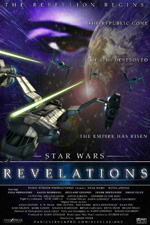
Star Wars: Revelations
I know I’m a bit behind on the whole bandwagon of checking out Star Wars: Revelations, but oh well. I have now downloaded it, burned it to a DVD, and watched it — so I feel confident that I can comment on it.

First off, though, a little about getting the movie — the nerdy part of me thought the challenge of getting it on DVD was almost better than the film itself.

On the movie download page, the two main file formats are QuickTime and Windows Media Player WMV. For the more geeky fans, there is also DivX and a bunch of formats for various hand-held devices. What really got me excited, though, was the DVD version of Revelations. My new notebook has the ability to burn DVDs, but I haven’t used it yet. I figured this would be a perfect learning opportunity.

Since the file is over 3GB, the creators of the film prefer that people get the film using BitTorrent. I had used BitTorrent in the past to download episodes of season 4 of The Surreal Life, so I figured it would be pretty straightforward and fast. Unfortunately, that wasn’t the case.

The BitTorrent files were taking forever to download. I was getting download speeds of only 33KB/sec, which meant that downloading would take well over 10 hours. I know my connection is faster, so that seemed insane. So despite the fact that the FTP wasn’t the preferred method, I went and downloaded my favorite FTP client, NcFTP (which supports resuming of failed/stopped/disconnected downloads), and started downloading. It took most of Saturday to download (but at least I was getting between 80KB/sec and 120KB/sec), but at least it was faster than BitTorrent.

Once I had the ISO image, I needed a way to burn it on to the blank DVD (a Memorex DVD-RW, for what it’s worth). Originally I figured that I could use burnatonce, a great little program I’ve used in the past to burn normal CD images. Unfortunately, I couldn’t figure out how to get burnatonce to work with DVDs, so I searched for another solution. I quickly found DVD Decrypter (which is apparently out of “print” but can still be found on download sites), which worked great. I thought it would take forever to burn a 3.5GB ISO image, but amazingly it only took 25 minutes or so.

With the burning completed this morning, I now had Star Wars: Revelations and was ready to watch it. (There is still the option of downloading the “specials” disc #2 with behind-the-scenes features and whatnot, but for now I’m content with just the film.)

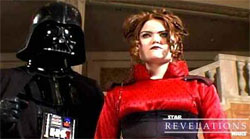
Darth Vader and Zhanna
As for the film itself, I have mixed feelings.

The special effects are amazing. The amount of CGI work done for this film (including light saber battles, space scenes, explosions, holograms, etc.) is spectacular. If someone were to splice a few of the shots into a “real” Star Wars film, I probably couldn’t tell the difference. The only complaint I have about the CGI work is that it is often “too realistic.” I’m not exactly sure how to describe it, but I think it has to do with the fact that the film was entirely digital, which left it without that somewhat grainy and theatrical feel that normal movies have. Everything was too crisp and clean to be in a movie.

As for the acting, however, I was pretty disappointed. I’m not sure how the film was cast, but as far as I can tell most of the characters are played by a group of friends — the director, for example, plays one of the main characters. For the amount of awesome CGI work that went into the project, I would’ve hoped that as much effort would have gone into casting. Not to say that the film was horrible or that the quality of acting reminded me of ninja and karate movies people made in high school (though at times it did have that feel…), but it definitely could have been better.

If I had to venture a guess, I would assume that the people behind the film had more of a technical/computer background rather than a theatre arts one — but I could be wrong (and I should probably research a bit before being so critical). If anything, I think that seeing the people in the film made me realize how difficult acting truly is and that we often take that for granted with most movies and television shows.

The story, on the other hand, was rather interesting. It takes place between Revenge of the Sith and A New Hope. The main character, Taryn Anwar, is a seer Jedi. In the past, the seers had been kicked out of the Jedi order, so Taryn is a bit of a rouge — perhaps? Prior to the film, she had been working for Zhanna, the Emperor’s Hand, to help exterminate the Jedi (which began in Revenge of the Sith). Eventually, Taryn teams up with some other Jedi’s to figure out the meaning of a mysterious artifact.

Spoiler ahead:

At the end, the “revelation” is that the seer Jedi’s foresaw the rise of Anakin Skywalker (or, more vaguely, a Jedi who would turn to the Dark Side). In order to prevent this from happening, they would on occasion kill Jedi who they feared might turn (which is probably part of the reason they were kicked out of the Jedi order). The seers setup a system to track all the Jedi’s in the universe — that was the secret of the artifact.

The final battle at the end is between Zhanna and Taryn over who gets to keep the list of all Jedis. Ultimately Zhanna escapes with the list, but Taryn’s friends make a copy so they have a list too. At the end, Darth Vader kills Zhanna (who he was jealous of), and will presumably take credit for having the list and hunting down the remaining Jedis. Taryn and her friends vow to protect as many Jedi as possible and plan to enlist the help of Senator Organa (from Revenge of the Sith and Leia’s adopted father).

Like I said, the story is interesting, and has a few twists that I didn’t mention. And there are a few “cameos” like Boba Fett and that strange eye machine that guards Jabba’s palace in Return of the Jedi that only true fans would think of including. (Though I don’t remember a character muttering, “I have a bad feeling about this…”)

I love the idea of having various “alternate universes” that are created with literature and film. The more complete these universes the better. I’ve posted about this before (on my old blog, though, I think), and I’ve concluded this enjoyment of “mythologies” is part of the reason I find soap operas and television shows so enjoyable.

I think it’s awesome that a bunch of fans got together to add to an alternate universe that they so obviously love. I truly hope that more people will add to the universe in such rich ways. Over at TheForce.Net there are a bunch of fan films that I will have to check out, but I have a feeling that none will compare to Revelations when it comes to visual effects, storyline complexity, and length.

I commend the makers and look forward to more fan-created work.

2046 Opening In Seattle

2046-2047
Finally!!! 2046 is opening in Seattle on August 26 and playing at the Harvard Exit Theatre.

I must say, that of all the Landmark Theatres in Seattle, the Harvard Exit is the best for foreign films because the seats are sloped enough so that people’s heads are not in the way and you can actually read the subtitles. We should all be thankful that, although the venue is larger, they aren’t showing it at The Neptune (which is where they showed it for SIFF).

The site doesn’t say how long it will be showing in Seattle, but I would guess that it is one or two weeks, so if you have any interest in seeing it, don’t wait — see it as soon as possible after the opening.

Dead or Alive OR ABSURD?

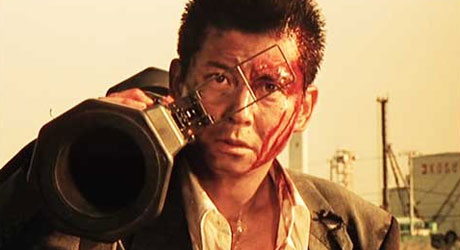
Capture from the finale of Dead or Alive
While watching Dead or Alive by Takashi Miike (who also did Izo, Audition, Visitor Q, etc.), I kept saying to myself, “Hmm, this is missing the absurdity that I love so much in Miike’s films!”

Then I got to the ending. I don’t want to spoil it for those who haven’t seen it, but it’s great. And absurd. And very Miike (as far as I can tell based on the three or so movies of his that I have seen already). Good times. I do recommend.

Moloch!

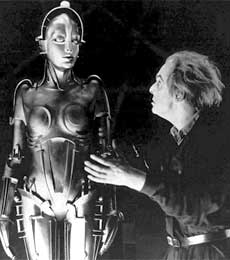
The Machine-Man and Rotwang
I watched the Kino Video version of Metropolis last night and I have to say that it is one of the best film restorations I’ve ever seen. The quality of this version of Metropolis rivals a lot of the Criterion Collection DVDs I’ve watched. For a movie made in 1927, the print was super-crisp (almost too crisp, if that is possible). In addition to the great quality, this version claims to be the most complete version of the film and even where the original negatives have been lost (so as to create missing scenes), the creators of the restoration included brief textual explanations about the missing sequences.

As for the film itself, I wish I wouldn’t have waited to long to watch it. I mentioned the Time magazine “9 Great Movies From Nine Decades” during my review of Bad Education, and while Talk To Her was the most recent (for 2000s), Metropolis was the first (for 1920s). Apparently that article has been on my mind lately.

Anyway, I totally understand why Metropolis would make the list — the movie was brilliant.

From my understanding, the lasting legacy of Metropolis has been its dystopian vision of the future, but I think the social and feminist themes it raises are also worthy of praise. This was quite a progressive film — and if I can be saying that in 2005, I wonder how it was received in 1927. (Perhaps it is more shocking now since, in my opinion, we have, in many ways, become more conservative in the past 20 years or so — maybe in 1927 people expected films to be more artistic and abstract and tackle philosophical and political issues…)

I definitely want to watch the film again, preferably with commentary. Since the film is silent, I can imagine that having people talk during it would help keep my attention — though I will say that the score for this film is quite gripping, and I am fairly certain that John Williams ripped off a few of the musical themes for Star Wars.

Sometimes when I watch these old “classic” movies, I do so with a little resentment — why should I have to watch such and such film if I want to consider myself to be someone who really appreciates good film. And why should I believe some old critics as to what makes good film and take their recommendations seriously since they tend to hate films I love such as Doom Generation and Lost Highway (okay, I guess some critics do like Lost Highway, but hopefully my point remains…). With Metropolis, I must admit that the critics and history of film criticism are correct — this is a great, must-see, important, artistic film.

Quizàs, Quizàs, Quizàs

Zahara
I now know of at least two instances when songs appear in films by Wong Kar-Wai and Pedro Almodóvar. It seems that Almodóvar is borrowing from WKW, but I can’t say for sure. All I know is that “Cucurrucucú Paloma” showed up in both Happy Together (WKW) and Talk To Her (Almodóvar) and that WKW used Nat King Cole’s version of “Quizàs, Quizàs, Quizàs” in In The Mood For Love and Almodóvar had a drag queen mimicking Sara Montiel perform it in Almodóvar’s latest, Bad Education (Spanish title: La mala educación).

I really am not sure what is going on with this back-and-forth, and I somehow doubt that Almodóvar and WKW know each other, but I love the fact that these two “difficult” and visually stunning directors are similarly inspired by the same music.

I hate to admit that I wasn’t very impressed with Talk To Her — generally considered to be Almodóvar’s masterpiece and one of the best films of the decade (according to Time magazine). Honestly, I think the movie was too hyped up for me and I plan to revisit it in the future.

Prior to Talk To Her, Almodóvar created All About My Mother, a movie I do genuinely love. It takes a lot for a movie to make me cry, but I vaguely recall crying when main character’s son is killed within the first fifteen minutes of the movie. That says something, if you ask me.

I’m not quite sure whether I like Bad Education more than All About My Mother, but I will say (immediately after watching it) that I do like it more than Talk To Her. Like Talk To Her it has a story-within-a-story thing going on, though I think what was toyed with in Talk To Her was more fully realized and better executed in Bad Education.

Another thing I love (in case you cannot tell by the title of my blog) is the idea of doubles. Sometimes I think my desire to “double” everything makes movies seem unnecessarily complicated to me (i.e. 2046), but overall I think it makes movies much more enjoyable for me. I loved that in Bad Education there were doubles and doubles of doubles and sometimes the person you though someone was a double of was in fact the double of someone else. Although it sounds confusing, Almodóvar knows what he’s doing and the movie is shockingly easy to follow.

Seeing Bad Education inspires me to check out some of Almodóvar’s earlier films and to re-watch All About My Mother. It also makes me want to give Talk To Her another chance — maybe in a couple of months or so. I’m not yet ready to call him one of my favorite directors, but I think the possibility is there.

Assembling Pieces of Time

On Sunday afternoon, when it was sunny and in the 80s in Seattle (during a relatively cold and rainy summer), I went to a lecture by Robert Horton, the curator of The Frye Art Gallery‘s The Magic Lantern “talks on film and art” series. I mentioned the talk the other day and gave some excerpts from programs I found online.

Overall, the talk was mediocre. I guess I’m more used to very academic talks at colleges, whereas this one was, I felt, geared more toward a general audience… which makes sense and, if nothing else, just shows how elitist I am. Oh well.

The Frye’s Oliver Herring: Taking and Making exhibit inspired Horton to do a talk about Wong Kar-Wai. In particular, Herring had a series of photographs arranged in the shape of an X (over about 20 feet or so) that told two stories. In the middle the stories intersected.

Horton compared this arrangement of photographs to motion pictures — since a film is, at its most basic level — a series of still photographs arranged horizontally in order to produce the “illusion of movement.” Horton also likened the X pattern to the multiple intersecting storylines often found in WKW’s movies (especially Chungking Express and As Tears Go By).

He also noted that WKW and Herring shared what, I believe, is a fairly common trait among artists: The act of creating the art is more important than the final product. Horton said that for Herring the objects (i.e. the art) was less interesting than the time he spent creating it. Likewise, Horton gave some history about WKW’s reluctance to finish pieces of work (he was shooting and editing parts of In the Mood for Love days before it preimierd at the Cannes Film Festival and actually changed 2046 a bit after it debuted at the Hong Kong Film Festival). Horton concluded that WKW loves the process of making the film, probably more than finishing the film.

The method of emphasizing the creation of the piece rather than the final product is, I would argue, a common theme in postmodern art. I think of things like Warhol’s studio or David Lynch using dead animals and insects to create pieces of art as being other examples of artists who value the process of making art more than the final piece.

Horton also gave some biographical information about WKW (born in Shanghai, moved to Hong Kong at age 5 during the early ’60s — no wonder he keeps returning to the ’60s in films like In the Mood for Love, The Hand (from Eros, and 2046), most importantly noting that WKW almost always collaborates with production designer/editor William Chang and cinematographer Christopher Doyle. Horton believes, as I’m sure many critics would agree, that Chang and Doyle add a great deal to the look and feel of WKW’s movies.

(As a side note, I am guessing that Horton has met Doyle at some point — Doyle was in Seattle for 2004 the Seattle International Film Festival — because he kept talking about how much Doyle partied and was a womanizer and whatnot. It was amusing.)

Horton then showed clips from four of WKW’s movies and discussed how these clips related to time and WKW’s non-straightforward method of producing films and storylines:

Days of Being Wild
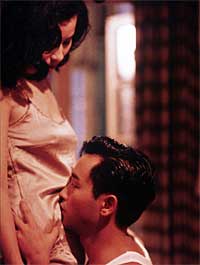
Su Lizhen and Yuddy
Scene: Yuddy and Su Lizhen meet for the first time. The scene starts with a clock — Yuddy tells Su Lizhen to watch the clock for a minute. Then he tells that for despite what happens in the future, they will always have this one minute in which they were friends. An unknown amount of time passes. Yuddy and Su Lizhen are in bed. She asks him to marry her, he rejects. She leaves him.

Given that time was a central component of the lecture, Horton noted that a scene starting with a clock was perfect for the lecture. He noted that we don’t see their relationship progress and that the time between their first encounter and the demise of the relationship is ambiguous.

He explained that many of WKW’s films are “memory films,” and that chronology isn’t always important — the essence of the film and the events is more important than anything else.

Apparently WKW wanted his films to look like the work of Edward Hopper because of the way Hopper’s work captures alienation and loneliness — a look which WKW developed in Days and has carried through in his films sense. The production design (color palette, architecture, etc.) is very deliberate and somewhat nostalgic. Horton kept using the term brick-a-brack (another postmodern artistic technique) to describe it.

Chungking Express

The Cop and Faye
Scene: The cop and Faye meet for the first time. The owner of Chungking Express gives the cop food/dating advice, encouraging the cop to bring two things from the Express back to her and give her a choice. Ultimately giving his girlfriend choices in food causes her to leave the cop. (~35 min. into the film)

“California Dreamin'” by The Mamas & The Papas blasts from Faye’s radio as the cop tries to order food from Faye. All of the characters sort of randomly appear and disappear (not in a bizarre way — they are in one scene, and not in the other — presumably off doing something else) in the scene. The only way we know that time has passed is by the changing of Faye’s outfit — there is no traditional fading in or out. Horton calls this syncopation.

Faye, especially, is a syncopated character. She randomly appears in people’s lives then disappears — especially when least expected. Horton notes that this reflects the nature of her character, as evidenced by her trespassing into the cop’s apartment.

With Chungking Express, Horton also notes that WKW rewards viewers for multiple viewings. The film is basically broken into two pieces: The first half dealing with the woman in the blonde wig and He, the cop; the second half dealing with the other cop and Faye. Bits and pieces from each half appear in the other, though in ways that are not obvious upon first viewing.

Horton also noted that Chungking Express was initially intended to be three parts, rather than two. The last part ultimately became Fallen Angels which, like Chungking Express then became a concatenation of two stories.

Fallen Angels

The Killer and his Partner
Scene: The Killer, one on of his assignments, goes into a restaurant or something to kill a group of people playing mahjong. After fleeing the scene he boards a bus where he runs into an old friend from school who tries to sell him insurance. He shows his “friend” a picture of his “wife” (a black woman he paid money to pose with him) and his “son” (a kid he bought ice cream for). He then contemplates the idea of an assassin having insurance benefits.

While the killer is killing a remix (or a remake??) of Massive Attack‘s “Karmacoma” is playing… I’m not familiar with the version of the song, though it sounds somewhat like the “Bumper Ball Dub” remix). I mention this because I love the song and loved that it was included in the movie and because Horton mentioned the song, as well.

Horton noted that throughout Fallen Angels, especially, WKW used wide angle lenses. They add a sort of distortion to the film, he argues. The wide angle lenses also made the scenes feel less claustrophobic (despite the fact they were since WKW shot on-location) and caused the people on the screen to look distanced, which captured the emotional feelings of many characters in the film.

From a technical standpoint, Horton also pointed out WKW’s use of step printing after the Killer leaves the restaurant and how it, also, distorts the scene. Step printing is a type of slow-motion filming that looks more like stop-animation. It’s hard to explain, unfortunately, but feels very disorienting.

The violence of the Killer’s assassination was nontraditional, Horton suggested, because of the quick cuts from different angles. Rather than helping the audience make sense of the moment, WKW made everything chaotic and appearing as a blur of color and movement. Horton went so far as to say that the frantic editing was like music.

Fallen Angels also makes use of narration (which becomes a WKW trademark in subsequent WKW movies — I don’t recall it in Chungking Express as much). Horton described the narration as “taking us out of the scene while we are still in it.” The narration also gave the main characters a chance to be more whimsical and ironic than the normal events of the film would let them be.

Finally, in regard to genre, Horton noted that WKW started off as a screenwriter mostly doing Hong Kong kung-fu and action-type movies. Fallen Angels, Horton explained, may have had the motif of a gangster movie, but that the film was really about other things (WKW favorites like loneliness, relationships, etc.) though it was “hung on the hanger of a gangster movie.”

Audience Questions & Comments 1

This part killed me. The thing I hate the most about lectures are the audience questions and comments. It seems people ask two types of questions: either they ask an inane question they could find the answer to (“what year did xxx come out?”) or a question that shows off their knowledge. I hate both types. Sometimes there is a good question, but mostly Q&As are lame.

Sample questions:

  • Was the murder while people were playing mahjong related to an “identical” murder that occurred in Seattle? — Are you joking me!! People are murdered all the time and the whole gangster stuff is pretty big in Asian cinema. I doubt WKW cares about crime in Seattle. Ugh.
  • WKW has an expectation of his audience — Duh.
  • First you fall in love with a WKW movie, then you get to know it. When the film finishes you have a sense of longing and you miss the characters. — Okay, I agree.
  • The films are physically gorgeous even if you don’t understand what is going on. — Okay, I agree with this comment, too.
  • Places are important to WKW. The backgrounds are a character. The frame is important. Everything is selected. — Horton had been saying the exact same thing all night… At least the person was listening.

Christopher Doyle

Doyle once told a story about Happy Together that Horton feels captures the chaotic style of WKW’s filmmaking process: Some of the supporting actors arrived in Argentina but WKW had no idea exactly who their characters were or how they were going to fit into the movie or anything. WKW starts without a script and then lets the characters find themselves (much to the annoyance of many actors). Doyle’s remark on this was something like: “The actors were waiting for their characters to come and WKW was hoping for the same thing at a coffee shop down the street.”

In the Mood For Love

Su Lizhen and Chow
Scene: Chow and Su Lizhen are in the alley acting out how they think their cheating significant others first met and started messing around. Some indefinite time passes and they are eating at a restaurant.

Some background Horton gave about In the Mood For Love: the shoot took 15 months (which is long), WKW was shooting the epilogue days before the Cannes premier, the actors didn’t have much direction and were told to “search for the material,” WKW wanted to shoot the entire thing on location — not on sets or soundstages, and the original title was Summer in Beijing.

The style of In the Mood is more like that of Days of Being Wild (not as jittery or random as Chungking or Fallen Angels), though with a more grown-up feel.

Originally, apparently, WKW wanted to do a 3-part film about food (?!?). Horton suggests that that is why there are so many scenes of people eating or at restaurants and why the food is almost fetishized.

Horton’s main discussion about In the Mood, however, focused on the deleted scenes and the Criterion Collection edition of In the Mood For Love.

Some of the most important deleted scenes make the relationship between Chow and Su Lizhen much more explicit. They make love (which is only vaguely alluded to — and never confirmed — in the “theatrical” version of the film), the cook together, they dance together, etc.

Horton argues that the existence and relative accessibility of these scenes (i.e. they aren’t locked away in a vault or anything — the Criterion Collection is, as far as I know, the only U.S. release of the film) alters the film in a sort of metaphysical way. The overall story is drastically changed in our heads forever now. Even though the scenes were “deleted,” they live in our head and change our understanding of the events in the movie.

DVDs can change the way films are understood and turn them into a constant work of art. The DVD is a new form of art with a new film on it. In order to really understand In the Mood For Love are we better off watching the DVD and seeing the “true” story, or should we ignore the deleted scenes and take the “theatrical” version as the definitive version.

What is interesting about this whole idea is that other directors, most notably George Lucas and Peter Jackson, have also embraced the DVD and/or re-releases of films in order to constantly work on their previous projects. Whereas Jackson has been commended for his DVDs, Lucas has mostly been criticized.

It’s a fine line, and I’m not sure where I fall when it comes to In the Mood — the unspoken and unseen love between Chow and Su Lizhen is one of the most beautiful aspects of the movie… but at the same time, I love existing in their world and seeing as much as possible. It’s hard.

And then, of course, how does 2046 fit into everything. It’s been described as a “loose sequel.” It definitely stands alone, but should it? Is 2046 just another permutation of the same project that In the Mood For Love is? And is In the Mood For Love just a sequel to Days of Being Wild anyway?

Horton then moved the conversation toward WKW’s fetishization of objects. He mentioned the food in the restaurant scene that started the In the Mood discussion and also remarked that WKW also fetishized music, people’s faces through extreme close-ups. intense colors and textures, jukeboxes, hair, and costumes (especially Su Lizhen’s in In the Mood). Again, he referred to this as brick-a-brack and theorized that it made everything more precious and important.

Audience Questions & Comments 2

Only the good ones:

  • WKW creates stories with the potential for viewers to explore. Everything is done through inclination and suggestion.
  • WKW has nostalgia for disappearing things… (which the audience member said was a theme in Asian film, which I thought was a rather dubious claim… it’s a theme everywhere).
  • WKW is not into conventional beauty. He likes things that are run-down and lived in.
  • The best comment: WKW is somewhat like Proust. They both constantly revise and rework their projects. They like to explore all the possibilities of their characters and situations. They both also focus on solitary characters who never “connect with their one true love.”
  • Film lends itself to memory.

2046

Horton made two comments about 2046: First, Chow’s character is more like Yuddy from Days than Chow from In the Mood; second, if 2046 is just an extension/exploration continuing In the Mood For Love and In the Mood For Love is an “adult” version of Days of Being Wild… so that basically all of WKW’s movies are different perspectives on the same theme, he doesn’t need to choose a “favorite,” per say — he loves them all.

Annoying Audience Members

Finally, I have to comment on how annoying some of the audience members were.

First, there were some old women toward the back of the auditorium who were talking throughout the lecture. Because they were old, I am guessing, they had to speak louder because they had lost their hearing or something. It was totally rude and they were ignorant about what they were doing.

Second, in a similar vein, there was another old woman who had a plastic bag that she sat and ruffled for quite a long time toward the end of the lecture. Nearly everyone in the auditorium looked back to give her “the evil eye” but, again, she was ignorant to how rude she was. It was very annoying.

Finally, there was an audience member who was trying to be all know-it-all and suggested that the title 2046 was a reference to the fact that it would be the 50th anniversary of Britain returning Hong Kong to China… well, as I noted in a previous review, the year is actually 2047. I am guessing that the guy read the same review I did and just got the dates confused. This is an example of someone asking a question only to show off.

Overall

… the lecture was interesting, probably more due to the fact that it was about a director I love than the content of the lecture. As I said before, I’m not entirely sure what the guy’s thesis was — if there was one at all. It started out with some interesting ideas on time in WKW films, then into WKW’s haphazard method of developing his storylines, and finally into the new continually evolving type of film that WKW has created with the deleted scenes on the Criterion DVD. I wish he would’ve included some discussion of Happy Together (the film that got me hooked on WKW), or As Tears Go By (WKW’s first, apparently more conventional film) or Ashes of Time (which, along with Tears, I have yet to watch). Nonetheless, it great to see someone else intellectually engaged with WKW’s work and maybe it will inspire me in some way that I have yet to realize.

Wong Kar-Wai Lecture in Seattle

On Sunday, July 17 at the Frye Art Museum in Seattle there is going to be a lecture about “assemblege” and the films of Wong Kar-Wai.

From the FRYE film calendar:

Wong Kar-wai: Assembling Pieces of Time
Related exhibition ~ Oliver Herring: Taking and Making
Sunday, July 17, 2 pm

Free passes available at the Information Desk at 1 pm

Like Oliver Herring’s sculptural portraits composed of countless fragments, films are assembled out of tiny pieces of still images. Wong Kar-wai, a director whose work inspires a rapturous response unlike any other filmmaker of his generation (In the Mood For Love, 2046), takes an extreme approach to the idea of assemblage. He and wild man cinematographer Chris Doyle regularly begin shooting without a clear concept of storyline—if indeed any story will emerge. Robert Horton describes Kar-wai’s method and the sensual, haunting results.

The Seattle Weekly‘s Visual Arts Calendar adds:

Magic Lantern Lecture Local film critic Robert Horton explores the parallels between the 3-D collage sculptures of Oliver Herring (now on display at the Frye) and the fragmentary films of director Wong Kar-wai. 2 p.m. Sun. July 17. Frye Art Museum, 704 Terry Ave., free, 206-622-9250.