Another CD Buying Binge

I really need to stop myself, but after seeing Childstar last night, I went to Tower Records (well, first I went to American Apparel and bought two shirts) and picked up eight CDs… and it only cost me like $35 (though a lot were singles). Somehow they had some massive clearance thing on a bunch of the CDs, and then there were a few CDs I’ve been wanting for a long time in the “just in” bin, so I couldn’t help myself:

  • “Nothing Really Matters” single by Madonna
  • “Sparks” single by Röyksopp
  • “Insomnia” single by Faithless
  • Camber Sands EP by Fatboy Slim
  • The Pimp EP by Fatboy Slim
  • Uh Huh Her by PJ Harvey
  • Echoes by the Rapture
  • We Love Life by Pulp

The really shitty thing is that my iPod is totally maxed out. After putting Demon Days on, I have only 18 MB left (and for the past 4 months, every time I add music I have to delete a bunch). I’m not sure what to do. Since a lot of the CDs are singles and I just wanted some of the remixes (especially the Kruder and Dorfmeister remix of “Nothing Really Matters”), I probably won’t put many of these new CDs on my iPod. The whole thing is silly. I’m such a junkie.

Review: Childstar

Childstar
The main reason I went to see Childstar was because Jennifer Jason Leigh was in it. The review said something about it being a movie about a Macaulay Culkin-esque child actor who is abducted.

Really, though, this film is about the Hollywood exploitation of child actors.

But I’m not sure what the ultimate message is, and that is probably the main weakness of the film. In the end, I wasn’t sure whether it was more a critique of the movie-making process or a argument against using child actors in films… and if it was about child actors, it’s rather ironic that in order to make the film, the filmmaker had to exploit the actor who played the child actor (Mark Rendall, who was amazing “for a kid”).

The story itself was rather uninteresting. The kid actor is cast in a joke-of-a-movie about the first son (which the kid plays). His dad, the president, is kidnapped by “European terrorists” (who are funny). Since his dad is gone, the first son has to be “the man of the house,” which, apparently, involves taking on the terrorists single-handedly and saving his dad. (The movie itself doesn’t show the sub-movie in its entirety — we are briefed about the plot in the opening when some agency is pitching it to a production company.)

What I found most interesting were the rather intertextual themes of the movie. The fact that it was a movie about a movie was pretty interesting and meta. I also liked the fact that one of the main characters was the driver for the kid actor and that the driver was also an aspiring director… and the fact that that character was also the director/writer of the film, Don McKellar. I just loved the fact that the director played a driver who was a wannabe director.

Also, I must add, that I’m always terribly delighted whenever Jennifer Jason Leigh is on the screen. Yes, she pretty much always plays the same role (kinda neurotic, possibly substance-abusing, etc.). She plays the kid actor’s mother in the movie and seems to be exploiting him pretty hardcore… plus, she hooks up with the driver, which is just weird.

Overall, I gave the movie a 4/5. In retrospect, it was probably more of a 3, but oh well. I also liked that it was Canadian.

Word of the Day: Veg*n

Vegetables
At work we have quite a lot of random list-serv type “groups” that we can join. My coworker, who is a vegetarian like myself, has been a part of the vegetarians group for quite a while. On a whim, my another coworker and I joined the group yesterday as well.

Let me say, it isn’t at all what I expected. I figured there might be two or three e-mails a week with tips on eating in the cafeteria, places in Seattle to eat, etc. Instead, I got something like 20 e-mails in the first day alone, with topics ranging from PETA’s recent crusade against Tyson to raising kids vegetarian to trying to convert others to the blood type diet.

These topics are all nice and fine to read about, but everything becomes a total flame war. People write huge multi-paragraph responses/rebuttles to every e-mail. It is quite intense!

Nonetheless, I did manage to pick up something useful: the term veg*n. The * (asterisk) in the middle is a wildcard symbol meaning “anything can go here,” so veg*n can refer to vegetarian or vegan. I love the term and intend to use it as often as possible.

Kunstler vs. Lovins

Salon.com has an interesting (and somewhat catty) exchange between James Howard Kunstler and Amory Lovings: “Sparks Fly.”

I don’t know much about Kunstler, save the Salon.com interview “After the oil is gone” from last week, but I have read Lovins’ Natural Capitalism and found it to be a really inspiring and thought-provoking book.

I’m not sure I would say I totally agree with or disagree with either Kunstler’s or Lovins’ arguments in the Salon piece. They book make valid points. I wish that their little back-and-forth dealt more with the deeper issues than technical/petty things (e.g. how Lovins’ paper “Winning the Oil Endgame” was peer-reviewed, the technical benefits of Lovins’ Rocky Mountain Institute campus, etc.).

Nonetheless, I’m always interested in reading about the new urbanist movement so the article was slightly informative.

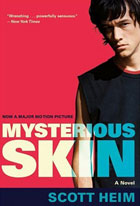
Mysterious Blue Skin

A U.F.O.
Mysterious Skin is broken down twice: First by colors (I just finished the “Blue” section), and then by characters (“Brian Lackey”, “Neil McCormick”, “Wendy Peterson”, and “Deborah Lackey”).

So far, this book is amazing. I’m usually not a fan of “gay literature” (and I wrote about why a few times during my Lesbian and Gay Literature class — I should post those journal entries sometime soon), but this book is different… it’s more “queer” than “gay” (again, something I theorized about in my journal entries).

Often times, marginalized literature tries to show people who aren’t in that marginalized group that the marginalized people are just like everyone else — they fall in love the same, they have the same hopes and dreams, etc. Mysterious Skin seems to be playing it both ways.

Brian Lackey is the “acned, bookworm” (96) who, within the first pages of the book, blacks-out during a Little League game. The same summer that the black-outs begin, Brian, his sister Deborah, and his mother witness some strange lights that they assume to be UFOs. The initial encounter propels Brian into a UFO obsession.

The black-outs, the obsession with the paranormal (Brian receives a book about the Loch Ness Monster for Christmas), and dropping-out of Little League creates tension between Brian and his father (who is obsessed with baseball and plays on a local team). Brian’s dad doesn’t think he is manly enough and somewhat girly.

Although it hasn’t been explicitly stated yet, it’s fairly obvious that Brian is gay. In addition to his awkwardness and shyness (which could also be due to his nerdiness, though), when him and his sister are watching a baseball game, he explains:

We watched the players’ bodies (7).

I once wrote a paper about the obsession with bodies within gay literature. I found it really significant that Brian noted watching the players bodies — not the players themselves or their swings or anything like that, but the players’ bodies. Additionally, Brian notes that other kids tease him by calling him “four eyes” and “pansy” (49). Pansy is pretty gay, yeah?

So far, the most striking incident from Brian’s childhood (to me) was the “initiation into manhood” that his father put him through. After returning from somewhere (church? a ball game? I cannot remember…), Brian’s family comes upon a large snapping turtle in the middle of the road. Brian’s dad gets excited about the idea of of turtle soup, so he manages to get the turtle into a bag in order to bring it home. Once home, Brian’s dad tells Brian that he wants Brian’s help with something — killing the turtle. Brian notes that he had carved fish before, but nothing had been as gruesome as killing the turtle. The whole scene comes across very violent and brutal. I kept thinking, “This is a very masculine thing to do — father and son slaughtering a snapping turtle.”

So basically, Brian is a nerdy, shy, quiet kid who loves UFOs and has a tense relationship with his mother and gets along really well with his sister (who ultimately moves to San Francisco after high school graduation). Although he seems like a nice kid, he seems pretty “normal” and ordinary. If he is indeed gay, he’s one of those “gays are just like straight people”-types, it seems.

Neil McCormick, on the other hand, is totally different. When he narrates there is a certain edge to his language — shorter sentences, more profanity and slang, etc.

Neil realizes pretty quickly that he is gay. One night during an intense storm, he crawls under his mom’s (who is single and dates a lot of different men) bed and finds a Playgirl magazine. He begins to fantasize about having sex with men (men with mustaches, hairy chests, etc. — which I find somewhat funny and gross at the same time).

Shortly after Neil figures that he likes men, the coach of his Little League team (which his mom signs him up for so she can spent more time with her boyfriend) takes interest in him — in a very sexual way. Neil notices this the first time they meet and it excites him — he likes being looked at and objectified as an object of desire:

His gaze paused on me. Desire sledge hammered my body, a sensation I wasn’t sure I had a name for (22).

The coach’s desire for Neil is realized pretty soon thereafter. The coach tells Neil that the team is going to watch a movie together. It turns out, however, that the coach lied and it was just him and Neil. The fact that the coach deceived Neil’s mother seems to turn him on:

It surprised me that he would like to Mom, but more than that, it excited me (27).

After the movie they return to the coach’s house, which is a total kid heaven (bean bag chairs, Atari, travel-sized cereal boxes [the kind that parents never buy], candy, etc.). The coach manages pretty quickly to get inside Neil’s pants and sex ensues:

I knew what was happening. Half of me realized it wasn’t right. The other half wanted it to happen (35)… It happened, I told myself; it happened. And I had liked it (37).

The book almost dares to ask: sometimes when a child is molested, does he/she enjoy it/want it to happen? Besides all of the potential issues of power and creepiness, it is something to ask (and something Foucault touches on in The Use of Pleasure. Of course, their relationship doesn’t last because the coach transfers to another Little League team (and then leaves town amid suspicions of his behavior). Neil longs for him, nonetheless. Oh, and every time the coach did something to Neil, he gave him a $5 bill.

The introduction of Wendy, Neil’s best friend, brings an interesting perspective. She basically fetishizes Neil as a gay boy and loves him because he is different. She sees him as something exotic that will spice up her life. Even the way he talks excites her:

From Neil, all those fucks and shits were more than just throwaway cuss words. They adopted some special meaning (55).

My favorite story that Wendy tells is about a “séance” where Neil makes a move on another (straight) boy. After Neil seduces/”hypnotizes” the kid, he gets on top of him and basically dry humps and then kisses him. This, of course, freaks the boy out. Despite being all macho, though, the boy cries. I just love the irony of it:

“Queer,” Robert P. said, plus something in Spanish. He was crying (57).

As for Wendy’s strange obsession/exoticization of Neil, at least she seems very aware of it. When she finally musters up the courage to talk to him, she recalls:

“You are a queer, aren’t you?” I said the Q-word as if it were synonymous with movie star or deity. There was something wonderful about the word, something that set him apart from everyone else, something I wanted to identify with… I was falling in love. Not so much with him, though, as with the aura of him (59).

I also loved the way Neil reacted (as explained by Wendy) to sex education in class. I’m also impressed with the fact that Neil knows he’s gay by fifth grade and isn’t afraid to be vocal about it:

“Ridiculous,” Neil whispered. “Not everyone fucks like that.” Some kids heard him, glared and sneered. “Some people take it up the ass” (62).

The story about Halloween is pretty traumatic. Neil and Wendy “kidnap” a retarded kid and nearly kill him when they put firecrackers in his mouth and light them off. When Wendy freaks out (rightly so) about the kid telling his parents about what Neil and Wendy did, Neil remedies the situation by giving the kid a blowjob. Neil explains:

“When I was little,” Neil said, “a man used to do this to me” (71).

That revelation disturbs Wendy:

Where had [Neil’s mother] been when the man from Neil’s past had put his mouth on her son like this? (72)

But ultimately she realizes the risk Neil took by revealing this to her:

Neil had shown a part of himself I knew he’d shown no one else. I reckoned I had asked for it. Now I was bound to him (74).

Deborah (Brian’s older sister)’s chapter mainly involves her observations about her brother (shy, no friends, etc.). It also tells their parents got divorced. Neither Brian nor Deborah seems too sad when their father leaves.

The final Neil chapter of the “Blue” section finds Neil becoming intrigued with the idea of hustling.

The idea of money for sex thrilled me like nothing before (85)… The idea of their wanting to pay for me rendered me breathless, thrilled, delirious, flustered (86).

When Neil manages to find a client, he can’t forget the coach, who treated him better:

While Coach’s fingers had “caressed” me, Charlie’s merely “touched” (88).

As Neil cums, the man swallows his load. The man notes that it wasn’t safe for him to do, but that since Neil was a kid it didn’t really matter since he knew Neil would be clean. Neil notes:

It was the first time I’d heard a man say that, but it wouldn’t be the last (89).

I can’t help but think this foreshadows, but who knows. Neil later discovers that when the guy swallowed he sorta bit his dick a little, causing it to bruise.

… so as the “Blue” section ends, it’s not at all clear how Brian is related to Chris and Wendy. We also don’t have any explicit proof that Brian is gay, but it seems rather obvious. I totally love this book. I haven’t been this excited/enthralled with nonfiction for quite a while (I loved The Handmaid’s Tale, but it didn’t get me excited and happy like this one does — it wasn’t joyful and funny like Mysterious Skin). I can’t wait to get further into the book and finally see how Greg Araki translates it to film.

On Depression

Over at Salon.com there is an excellent piece about depression: “Van Gogh on Prozac.”

The piece actually goes into some things I’ve been wanting to post about for quite a while actually, especially based on some recent conversations I’ve had with various people about the nature of depression, the definition of “normal,” the use of prescription medicines to treat mental “illness,” and so on.

First, as a bit of a disclaimer, I am not on any medication. I do not consider myself depressed. At times in my life, I think I probably was (so was it really depression? I don’t know) and considered seeking out therapy and/or medication to help me. That said, I have quite a few friends who are either taking medication, once took medication, or decided not to take medication. I also had a friend in college commit suicide after starting an antidepressant. I also know someone who is a psychology graduate student who seems convinced that I have quite a few psychological problems and is a strong proponent of cognitive behavior therapy.

All that said, I think it’s fair to say that I spend quite a bit of time thinking about mental health issues and have given a lot of thought to the intricacies and whatnot of the issue. Also, the next book I plan to read is Michel Foucault’s Madness and Civilization: A History of Insanity in the Age of Reason (which may not have to do with depression, necessarily, but, I imagine, involves some similar modes of thought).

The most enlightening conversation I had about antidepressants was with a friend of mine who has been taking them for years. I would consider him to be an “artist” (he is currently getting an MFA) and an intellectual. I asked him once whether he felt the antidepressants affected his ability to get in touch with his feelings and produce art. I was, at the time (and maybe still am?), enamored by the idea of the “tortured artist” who is depressed and lonely and all that, sitting alone somewhere creating great works of art that speak to the human existence and the truth of the world and stuff. My friend, however, said that since he started antidepressants, he found he was able to be more prolific because he was more focused and not so blasé about life. He also said that prior to antidepressants, he was more interested in imagery and poetry and that now his poetry isn’t as much like that. (The conversation was a while ago, so I don’t remember many of the specifics.)

Another conversation I remember took place during college. One of my friends was talking to another friend who was on antidepressants, and the friend who wasn’t, but would probably claim that he had some sort of depression, kept talking about how he was glad he wasn’t on antidepressants because he was afraid that they would affect his artistic integrity. As I recall (or maybe this is me being dramatic), my friend, who was on antidepressants, made a comment about how if it weren’t for the antidepressants, she probably wouldn’t be alive and functioning, so he should shut up and stop being pretentious.

Both of these little stories touch on the common belief that somehow equates a depressed person with an artist who is in touch with the truth and brutality of human existence.

The author (Peter Kramer, who wrote Listening to Prozac and Against Depression) interviewed in the Salon.com article strongly disagrees with this point. The article makes his point clear:

Depression, in many people’s minds, is integral to the creative temperament. We might lose some of the triumphs of art and culture if it were wiped away.

This vision of depression [of “the depression was not her fundamental self, or a window into buried feelings”] flies in the face of the common belief that the depressed are deeper and more authentic than the cheerful rabble. Kramer rails against the notion that depression is the only honest, thoughtful response to a cruel world, that we must choose between despair (or a kind of sardonic brooding) and a plastic, smiley-face mask of denial.

The psychology student that I know makes a claim like this. He says that because, he claims, I am so aware of the “cruel world,” that the only way I know how to cope is with “sardonic brooding.” So this example really struck me.

Based on the article, it sounds like Kramer advocates a combination of antidepressants and therapy. I’m willing to bet that the “therapy” involved would be cognitive therapy.

Cognitive therapy, based on my understanding, basically means making the patient self-aware of small things that he or she can do in order to make his or her life more livable. That is, make the patient cognitive of negative behaviors so that the patient can change them.

To me, and based on the psychology guy’s attempt at using cognitive therapy on me, this can be pretty torturous to the patient. Imagine feeling depressed or insecure or anxious and going to a therapist and having him or her tell you that the key to being happier is being more social. Well duh, you probably knew that already… but you don’t feel like being social. So as part of the therapy, the therapist tells you to go to a crowded mall every weekend and spend an hour walking around. Gradually over time, increase that to two hours, three hours, whatever.

As far as I can tell, when cognitive therapy doesn’t work, the blame seems to fall on the patient because he or she wasn’t trying hard enough to change or whatever or worse yet, that the patient “doesn’t really want to change.” This really pisses me off.

Cognitive therapy, in my opinion, is just trying to candy-coat one’s condition (if that metaphor makes sense?). Rather than really treating the underlying issue (anxiety, failure to get over some trauma from the past, etc.), the therapist just tells the patient to “be more happy” and “try harder at life.” If that doesn’t work, the patient is blamed (not explicitly, but rather indirectly) and probably ends up feeling more anxious.

One of the reasons I think I still like psychoanalysis, from some perspective, is that it looks to identify some “core” or “kernel” of a problem (“my mother was distant”, “I saw two dogs fucking when I was three years old”, whatever) and goes to that root in order to deal with your current problems. Yes, a lot of these root problems are ridiculous, so maybe it’s the belief that there is something deep down that can solve (not cover) the problem.

This loops back, again, to my overall theory of therapy. The psychology major I know argues that the goal of psychology is to allow the patient to live a happy life and function in society. I, on the other hand, think that psychology should solve the problem that makes the patient unhappy.

All this said, I’m no expert on any of these topics — like I said, I just think about them a lot. If this ever gets picked up by Google, I’m sure I can expect a barrage of angry psychology students debunking my thoughts. Oh well. That’ll just make me more anxious anyway.

The Best Line From a Star Wars Review

… the winner of the best line from a Star Wars: Episode III: Revenge of the Sith review goes to David Edelstein over at Slate, where, in “The Passion of the Sith: I dream of Jedi” he wrote:

McDiarmid isn’t the subtlest of satanic tempters. With his lisp and his clammy little leer, he looks like an old queen keen on trading an aging butt-boy (Count Dooku) for fresh meat—which leaves Anakin looking more and more like a 15-watt bulb.

Maybe this is why the movie disappointed me. The whole Emperor/Anakin thing sorta did gross me out because it seemed as if the Emperor was totally hot for him… giving gays everywhere a bad name. (And also resurrecting one of the oldest gay stereotypes: the old gay man/lesbian tempting the young, innocent into the ways of queerness.)

Starting Mysterious Skin

Mysterious Skin
In my continual stop-and-start of book reading (I recently started, then stopped, Infinite Jest, then I started, then stopped, Speculum of the Other Woman [for the third time]), and now I’m starting yet another book. This time, though, I need to finish it since I’m seeing the movie it was based on in a couple of weeks.

My next book is Mysterious Skin by Scott Heim.

I don’t know too much about the book, except for the fact that is is probably gay-themed and involves alien abductions (that probably aren’t really done by aliens). I know nothing about the author, so this should be pretty exciting.

I’m reading it because on June 2, I will be seeing the film version of Mysterious Skin as part of the Seattle International Film Festival. Greg Araki, who directed two movies I absolutely love: The Doom Generation and Nowhere.

Araki’s other movies are very sexual and surreal. Nowhere, in fact, seems to have been very inspired by the Bret Easton Ellis novel Less Than Zero. The film version of Less Than Zero absolutely sucks, so I just pretend that Nowhere was the real adapatation.

That said, I’m excited to start reading this novel. With the except of Infinite Jest (which, of course, I took a break from reading), I haven’t read a nonfiction book for a few months (The Handmaid’s Tale was the last one I read).

Feast Your Eyes

Seattle International Film Festival cover
Last year I was a bad Seattle-ite and didn’t get around to going to any of the Seattle International Film Festival showings. I tried going to see The Corporation, but I didn’t understand the whole pass/buy-your-ticket-in-advance concept back then and I ended up not seeing it when I wanted. But that was last year. And I am glad to say I learned from my mistake.

This year, I am going to go much more full-force with the whole SIFF thing. So far we’re only about four days into the festival, and I’ve seen three SIFF showings — yay for me.

On Friday night and Saturday afternoon (yes, twice) I went to see 2046. Readers of my blog should know that I’ve already seen the movie twice (first review of 2046, second review of 2046). I gotta say that seeing it three, then four, times only made me love the movie more. Every time I’ve watched it I’ve picked up on something different and understood things a bit differently.

Bai Ling
At the Saturday showing the woman from SIFF who introduced the film said a few interesting things. First, she said that she had worked with Wong Kar-Wai on his last five movies and that she asked him to come to Seattle for the debut of 2046. Second, she said that he had to decline because he was working on his next movie, The Lady From Shanghai with Nicole Kidman. As of right now, the Internet Movie Database notes that the film is in production without any cast listed. There are some rumors on the message board that Nicole Kidman would be involved, but nothing concrete… so, it seems to me that we may have been the first to really find out for certain that Kidman is in the next WKW movie. That is awesome. Finally, the woman said that WKW thanked us for seeing the film at SIFF and not going to Scarecrow Video to rent the bootleg/import version of the film. Oops. Well, I guess he didn’t personally thank me, but hey, I saw the SIFF screening twice, so it’s not like I took away business.

Speaking of 2046, when I first mentioned that it would be showing at SIFF I noted that there are apparently two edits of the film. After its Cannes 2004 premiere, WKW went and edited a bit so that it made more sense. I am 90% sure that the version I saw at SIFF was different than the version I watched on DVD. The “2046” and “2047” segments were longer and overall the film made more sense, though that could be due to the fact I had seen it so many times before and the fact I was watching it on a big screen.

Finally, and this is my last comment about 2046 and SIFF, but I have to say that The Neptune theatre in the University District is by far the worst movie ever to see subtitled films at. The floor isn’t sloped enough so the head of the person in front of you is always in the way. Again, learning from my past, when I went on Saturday afternoon we got the front row seats on the balcony, which at least gave us a chance to read all of the subtitles… as for the comfort, that still left a lot to be desired. That place needs new seats!

Secret Festival pass
In addition to the regular films at the festival, my coworker learned about this thing called The Secret Festival. Every year SIFF (and this is, I understand, pretty unique to SIFF) does this additional set of movies that you can see but not talk about. How serious are they about not talking about it? Well, pretty serious, apparently. Using my pretty keen Google-fu, I couldn’t find anything online about what has been shown in the past. Additionally, when you get the pass, you sign what is basically a nondisclosure agreement:

I, the undersigned, do hereby solemnly swear that I will never divulge the titles of discuss any of the films screened at the 2005 SIFF Secret Festival. Futhermore, I agree that I will not commit to print, broadcast on radio/television, on-line service or any other media form information regarding any of the 2005 Secret Festival screenings. I understand that the Seattle International Film Festival can and will pursue legal action against me in order to recover punitive and financial damages caused by my breach of this contract. I understand that no recording device is allowed into festival venues and that I may be subject to physical search of my person or personal property upon entrance to festival venues.

So yah, don’t expect any more information about the Secret Festival showings.

As for the other films, this is what I plan to see:

  • Ronda Nocturna @ Harvard Exit @ May 25, 2005 9:30 p.m.
  • Childstar @ Neptune Theatre @ May 27, 2005 7:15 p.m.
  • Izo @ Egyptian Theatre @ May 28, 2005 11:55 p.m.
  • November @ Neptune Theatre @ May 31, 2005 9:30 p.m.
  • Mysterious Skin @ Egyptian Theatre @ Jun 2, 2005 9:15 p.m.
  • A Hole in My Heart @ Egyptian Theatre @ Jun 4, 2005 11:55 p.m.
  • L’Amant @ Harvard Exit @ Jun 5, 2005 6:30 p.m.
  • Clean @ Harvard Exit @ Jun 7, 2005 9:30 p.m.
  • Ellie Parker @ Neptune Theatre @ Jun 11, 2005 2:00 p.m.
  • Frozen @ Harvard Exit @ Jun 12, 2005 4:15 p.m.

So yeah, within the next month my ass will become very sore and I will be an expert at taking the 7 bus route between my place and the U-District (for the Neptune showings).

It would be totally awesome for people to join me at any of these movies. And I do intend to review each film I see as much as possible, though it could become rather overwhelming.

What am I most excited about? Right now, Mysterious Skin because I love Greg Araki (Nowhere, The Doom Generation) and I love Joseph Gordon-Levitt. I am also excited about Clean because Maggie Cheung was great in In the Mood For Love and because the film involves heroin addicts and rock stars. As for the rest, we’ll see.

Wish me luck!