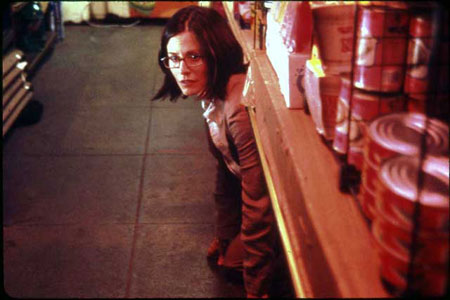
Review: Clean

Maggie Cheung in Clean
Of all the movies so far that have stood a chance of being called “The Best SIFF Movie So Far” (I don’t think that 2046 or Mysterious Skin should be up for that title since they are sort of in a league of their own — being objects of my obsession and all…), Clean would easily win hands-down. This movie was excellent: great acting, great music, great cameos, great story.

To briefly summarize the movie: Maggie Cheung plays Emily. At the beginning of the movie, Emily is with her boyfriend Lee. They are rockers. Lee is an aging rocker, but they are rockers nonetheless. They are also heroin addicts. After a fight, Emily leaves a motel room they are staying in to shoot up alone. When she returns the next morning, she finds the police at the motel because Lee has died of an overdose. She spends six months in rehab and then tries to deal with entering the real world sober. It also turns out that Emily and Lee have a son, Jay, who has been left in the care of Lee’s parents (Lee’s father, Albrecht, is played by Nick Nolte), who live in Vancouver. Albrecht meets with Emily and tells her that until she gets her life back together, he doesn’t think she should see Jay — the kid needs stability, etc. in his life. So once out of jail, Emily spends most of the movie trying to get her life back in order so she can be back with her son. Things go pretty well (she first has a job as a waitress, which doesn’t work out, but she does ultimately end up working at a department store, apparently) and she convinces Albrecht to see Jay. Their meeting, which has a rough start, ends up pretty okay. At the end of the movie, Albrecht agrees to let Emily take care of Jay and Emily goes off to record an album with a woman she met while in prison.

Okay, so that synopsis doesn’t get to the emotional value of the movie, but trust me: it’s great.

I have seen some interviews where Cheung mentions that this role was a difficult (from her acceptance speech at Cannes 04 (where she won best actress for the role): “It was difficult to play but not the most difficult, technically speaking. It was difficult because it was painful”) role for her, and she pulled it off tremendously. No surprise here that she won best actress. I also saw somewhere that is somewhat of a “break-through” role for her in the West, since prior to Clean she had been cast in non-Asian movies as a stereotypically beautiful, quiet Asian woman, and this role really gave her a chance to break from the mold.

As for Nolte, I have to say: he impresses me. I’ve really only seem him previously in Lorenzo’s Oil, U-Turn, and Affliction. Affliction is definitely one of the movies that has stayed with me ever since I saw it, and although I don’t think about it often, I would easily say is one of my favorite movies. He has an uncanny ability to play that raw, emotional, weak-but-gruff character and he does a great job as Albrecht — reluctant to trust Emily, but at the same time all-too-aware that her son is all she has left and that the two of them need each other.

Music is, obviously, a central theme of this movie since Emily was a rocker. A lot of the songs were very shoegazer and ambient -like… and that would make since because David Roback of Mazzy Star was involved with the movie (see the cameos below). The cloudy, atmospheric music definitely helped shape the mood of the film. It’s all-too-easy to include lots of pop-type songs in a drug movie soundtrack (see: Trainspotting, Casino, etc.), but I think the subtly of the music in Clean made it all the more powerful.

One scene, in particular, that I loved was when Emily was playing pool with a friend. She had recorded a demo tape while in prison and wanted her friend to check it out. The friend put on a pair of headphones and listened to the song while playing pool. While she was listening, the soundtrack for the song was turned way up, but you could still sort of hear the background noise — much like really listening to music on headphones.

The film also had some great cameo appearances. I am always delighted to see Tricky in movies. I’ve previously seen him in The Fifth Element, though that was a “character” role. In Clean he played himself — and he apparently talked to Albrecht often and was friends with Lee. Emily tried getting him to talk to Albrecht about seeing her son at one point, but Tricky was being somewhat of an asshole and wouldn’t help her. It was great. The other cameo appearance was David Roback (as mentioned above). He was one of the pivotal members of Mazzy Star, and probably did more than anyone to establish their wall-of-guitar sound. In Clean he plays himself as a record producer who works with Emily at the end of the film. The song the two of them create (which Cheung performs) at the end, “Down in the Light,” was hauntingly wonderful, and made me wish that the two would collaborate on an entire album. We can wish, at least.

Two more things of note:

First, the film made great use of oners (long, continuous shots). I specifically remember one that must have lasted about two or three minutes (which is considered long in film — especially nowadays when shots are so quick) when Emily was working in the restaurant. The camera followed her from a table down some stairs to the bathroom to outside where she smoked and back into the restaurant. It was lovely.

Second, when Jay tells Emily that he hates her because she killed her father and that people who use drugs are bad, weak, etc. Emily responds with something to the effect of: your father was in a lot of pain, drugs helped him, he was brilliant, drugs are fun sometimes, your father and I had lots of fun with drugs, but we paid the price, what they tell you about drugs (they are bad, for weak people, etc.) doesn’t address how complicated they are. It was probably one of the best realistic, anti-drug speeches I’ve heard.

In case my introduction didn’t make it apparent, I gave this movie 5/5. I hope it gets a wider U.S. release, as I really think it deserves wider exposure.

206-415-xxxx

In case anyone wonders, my phone number is 206-412-xxxx (yes, I am intentionally x’ing it out). Apparently there is someone with the phone number 206-415-xxxx that calls a lot of people… and doesn’t leave messages (i.e. the number shows up on people’s caller IDs).

So for the past few weeks I’ve been getting random phone calls from people (all across the country) calling and telling me that they were returning my call. “Huh?” I ask. “I saw your number on my caller ID… I am returning your call.” “But I didn’t call you…” “Well I have your number on my caller ID…” “What phone number do you have?” “2-0-6-4-1-5-x-x-x-x” “Yeah, that’s not my number. I’m 4-1-2.” “Oh, sorry…”

Seriously — conversations just like that numerous times.

On Tuesday I got a call at 7:30 a.m. (I wake up at 9:30 a.m., so this was quite early). I got a little upset: “Why are you calling me?? I’m 4-1-2!!” “Oh, sorry…” “No, why? How did you mess up the 5 and the 2?? This happens all the time! I want to know what happened?” “Sorry, I’m not sure. Goodbye.”

Argh!!!!

I honestly feel like I’m in a movie and/or there is some conspiracy trying to make me crazy. I have tried to call this 206-415-xxxx number and it is always busy.

My working theory is that this phone number is hooked up to a modem or fax machine that is constantly calling random numbers… then the people see it on their missed calls list and somehow call me back.

The thing is, if the number is on their caller ID, how are they always messing it up and calling me instead of who really called? I understand that 2 and 5 can look somewhat similar on an LED screen… but still!! Argh. This is driving me insane. So I guess the ultimate evil scheme is working? Grrr….

Update: September 26, 2005:
I am turning comments off. This has become nothing more than a “me too!” fest.

Review: L’Amant

So far I’ve been mostly happy with the film I’ve seen as part of the Seattle International Film Festival. Not all of them have been 5s, but I’m still glad I spent my money seeing them.

That changed last night when I saw L’Amant, a Japanese film about a girl who is purchased by three men (two infertile, one impotent) to be thier personal sex slave for a year.

I had hoped that the movie might be edgy or controversial in the same vein of Lies or Audition or even A Hole in My Heart (from the night before). Not so, with L’Amant.

The film is just about how these three older men oogle over their sex slave. Along the way, a girl befriends her because she is jealous of her hickey. Then that girl’s younger brother seems to fall for her. Then the girl is raped by some other (younger) guy and she gets pregnant, so the other girl’s younger brother tries to help her… but her “owners” are upset she had sex with somene else (and we never really finds out — can she perform an abortion by “touching her womb”??). In the end, of course, the girl ends up loving the three men who bought her (or something like love — she doesn’t hate them, that’s for sure). Like I said, pretty lame.

I gave the film 2/5 stars.

Review: A Hole in My Heart

Tess in A Hole in My Heart
What is it about a “film” that can distinguish it from “pornography”? What is the difference between acting and exploiting? After seeing A Hole in My Heart, I’ve been doing some serious thinking about these ideas.

When he introduced the film, the SIFF guy made a comment like, “It’s always nice to see an audience challenged.” This movie certainly challenged its audience. I wonder what it is about filmgoers that makes us want to be challenged in such ways. There is no complex way of putting this: A Hole in My Heart was gross and disturbing… but I liked it.

The movie sort of reminded me of Lies. The most basic explanation of the movie is, like Lies, people become consumed with their sexuality and feel the need to push the limits in order to achieve more interesting pleasure.

A Hole in My Heart follows four people: Rickard, Eric, Tess, and Geko. Rickard creates/films porno films staring Tess and Geko (sometimes he participates). Eric is Rickard’s shut-in, gothic son who basically spends the entire movie in his room.

There isn’t too much of a plot with this film. It’s more like a series of episodic moments. For example, I thought the climax of the movie might have been when Geko complains about the smell of Tess’ pussy (behind her back — which is what pisses her off) and Tess packs her things and storms off. I figure Rickard and Geko will be forced to come to terms with their behavior and somehow change. Nope. Instead, Rickard and Geko turn their abuse to Eric (forcing him to shoot airguns — at the tits and pussy of a poster of a naked woman). Tess returns shortly thereafter (with food!!) and the insanity continues.

The movie is extremely claustrophobic. Basically everything happens within the confines of the apartment. The two or three scenes that don’t happen in the apartment feel really strange.

The camerawork is very experimental/artistic. Many of the scenes (especially those taped during the taping of a porno) are very shaky and handheld. Digital perhaps? The decision makes sense, of course, since it captures the really raw aspect of what happens. There are also some scenes shot with a night vision camera (green skin, beady eyes a la Paris Hilton included!) that feel like some sort of confession. Another interesting camera technique to note is the selective blurring. Like a reality show, brand names and whatnot are often blurred… but there are also a few scenes when the peoples faces (both strangers and the main characters) are blurred as well. This is very unsettling and it seems rather profound, so I wanted to mention it.

The best (technically) aspect of the film is the sound design. The movie, obviously, is pretty uncomfortable. The sound really reinforces this with loud screeching noises a la David Lynch’s Lost Highway. There is also lots of feedback and distortion -type noises throughout the film. It also seems that the “music” Eric listens to is nothing but abstract, noisy soundscapes. More than a few times I could’ve sworn that the noises were sampled from Primal Scream’s XTRMTR album, in fact.

As for the taboos this film addresses, there are plenty: pubic hair shaving, overweight and hairy men having sex, vomit, piss, threesomes, rape scenes/gangbangs, latent homosexuality, incest, body odors, and on and on. There is also some underlying theme dealing with bodily modification and there are quite a few cut-ins of random surgeries that are really interesting — they look so visceral and gross. It’s weird.

A final aspect I need to mention is the anti-misogyny of the film. Rickard and Geko are obviously misogynist and treat Tess horribly. There is a “pseudo”-rape scene that is brutal to watch. Basically Rickard and Geko decide to “rape” Tess without letting her know. It’s the most difficult part of the film, I think, and it’s obvious that the filmmaker is trying to show the evilness of men. Likewise, there is a particularly memorable scene where Eric makes a statement to the effect of:

What do the sickest people, rapists, and people who start wars all have in common? They are all men.

I have to say, I agree, and I wonder if that is maybe one of the larger themes of the film?

Overall, I gave this movie 3/5. I wanted to give it a 4, but in the end it felt more like a shocking-for-shocks-sake art film. I wasn’t quite sure what the director was trying to say. If he just wanted me to think things over, then I guess he succeeded, but I’m guessing there was more going on — it was just too oblique for me to know.

Review: Mysterious Skin

Neil in Mysterious Skin
The film was great. It definitely ranks up there with some of the best book-to-film adaptations ever. The acting was superb. The music was haunting. And the message was preserved.

I’ve always thought that The Virgin Suicides was the best book-to-film adaptation ever. The light, ethereal cinematography combined with the amazingly ambient score by the French band Air really enhanced the content of the book, elevating the film version to something greater than just a stand-alone movie. I also thought that Requiem for a Dream surpassed the novel (which was rather difficult to get through due to its lack of punctuation, etc.), not only because it made the material more accessible, but also because the jerky and oftentimes experimental filming style really captured the feelings of the characters and their situations. Most of the time, I’ve noticed, when I enjoy a movie better than a book (or think the movie is as good as the book), it is because the filmmaker did something unique to express an idea in the book that can be done better visually.

Surprisingly, that was not the case with Mysterious Skin. The movie is pretty much a one-to-one adaptation of the book. Some of the major differences/exclusions I noticed:

  • During the Halloween part (when they were eight years old), as Brian is entering the haunted house, him and Neil make eye contact.
  • In the movie, Neil doesn’t discover the Playgirl magazines stashed under his mom’s bed.
  • The movie doesn’t explain that Brian’s dad leaves the family and divorces his mom.
  • The book has a scene before Brian and Mrs. Lackey watch the World of Mystery television show where they go fishing — I thought it was cool to see them bond.
  • The scene where Neil, Neil’s mom, and Eric go to the white trash diner and then the nature reserve (where they eat cheese and drink wine) was removed.
  • Neil gets a got at “Subz” in the film and it is after leaving there that he meets the guy who rapes him. In the book, the guy is waiting outside of the hustler bar (one of the “cheap ones” who doesn’t go in the bar but waits for the hustlers who can’t get business that night).
  • In the book, Neil sort of makes a friend at the hustler bar.
  • In the book, after being raped, Neil makes a comment about never wanting to touch his ass again — I thought this was really significant, but I can see how it would be tough to translate into film.

Despite that (somewhat?) long list, the movie really was extremely faithful to the book. In a Q&A after the film, Gregg Araki explained that ever since reading the novel, he has always wanted to basically translate it to the screen. I think his careful adaptation preserves the importance and delicate subject matter of the book without adding the director’s own flashy trademarks. As someone who just finished reading the book a few days ago, I was very pleased.

As for the acting, of course, Joseph Gordon-Levitt as Neil (the gay one who is a hustler) was great — and he had the perfect body for the part (dark hair, dark eyes, waif-thin, etc.). What blew me away most was the acting of Chase Ellison who played Neil at age eight. The kid totally had me convinced that he was a horny and somewhat manipulative (not to mention confused and rather messed-up/abused).

One of the things Araki discussed at the Q&A was the fact that it was very important to him and the crew that the young actors were “shielded” from the content of the film. I am guessing that this meant that the young actors basically didn’t know what they were doing — they were just acting however the director told them to act (“look sad”, “look shocked”, “look uncomfortable”, etc.). Araki said that with young actors, you don’t really tell them about their character by giving them back story or explain what is going through that characters head — instead, you just tell the kid actor exactly what to do, and that’s what they do. I thought this, while pretty intuitive, was interesting and seeing how well it worked in Mysterious Skin is really, I think, a testament to how skilled Araki is as a director.

My only qualm about the acting/characters is that we didn’t see much Elisabeth Shue. Granted, her part in the book wasn’t much bigger, but I would’ve loved to see her on-screen more. Oh well.

When it comes to the music, there is where I think my love for Greg Araki really intensifies. As I recently mentioned, I became rather obsessed with the music of Nowhere and The Doom Generation. While the music for Mysterious Skin wasn’t as random/”pop” (as in “pop” as opposed to classical/arranged/score music), it was still just as appropriate and moving.

Robin Guthrie, of the Cocteau Twins (who Araki has used extensively on soundtracks in the past and who are one of the major players in that whole shoegaze music movement), worked with Harold Budd (who worked with Brian Eno back in the day) to create an extremely ambient and moody soundtrack. Araki mentioned during the Q&A that he has the soundtrack album and listens to it constantly. He also noted that shoegaze music was influential on both him and the writer of the novel (Scott Heim).

In addition to the score, I also remembered hearing “Dagger” by Slowdive, a song or two by Cocteau Twins, a song by Medicine, and a song by Sigur Rós. During the Q&A, Araki mentioned that there was a song by Curve, but I don’t think so — though I know he used them in The Doom Generation and Nowhere.

Overall, I, of course, gave this movie 5/5. It was touching and very well-done. And I was also impressed with Araki’s ability to break from his trademark style (“satirical, postmodern, and ironic” — I think is how he described it last night) to something more subtle and serious.

Gregg Araki Tonight

Gregg Araki
In a super exciting turn of events, it appears that Gregg Araki (the director) will be at tonight’s showing of Mysterious Skin. This is really awesome, and the fact he will also be at Saturday afternoon’s showing makes me want to go see it again (depending on how much I like or dislike the film tonight, I may buy a Saturday ticket).

Back during high school there was a time when he was probably one of my favorite directors. Movies like The Doom Generation and Nowhere really sort of, I don’t know, inspired me? as a high schooler in Minnesota. The films were totally about a world and life so far away (Los Angeles) but at the same time sort of gave me something to fantasize about and all that? I don’t know exactly. I just remember watching those two movies, in particular, and wishing that I could hangout with the characters.

I also remember loving the music in both of the films. I, of course, have the soundtrack to both Nowhere and The Doom Generation, but there were also tons of tons that were not on the soundtrack. I specifically remember spending a weekend watching Nowhere over and over again, identifying each song and writing a little description about when it played then going on to Napster or some file sharing program to get that song. I actually still have the yellow legal pads where I recorded all of this information stashed away somewhere in my apartment now.

The soundtracks featured groups that were somewhat obscure but that I still loved like Slowdive (where I first heard the song “Avalyn I” [as Dark played by James Duvall masturbates in the shower]), Catherine Wheel, Lush, Cocteau Twins, Sonic Youth (the b-side “Hendrix Necro” even!!), Curve, Blur, Jesus and Mary Chain, Portishead, Love and Rockets, Wolfgang Press, Ride, Medicine, Pizacatto Five, Belly, and many more. Basically, the soundtrack was very 4AD (record label) and shoegaze -heavy. I can honestly say that the music of Gregg Araki’s films have greatly influenced my taste in music in general.

Further, there is a line from Totally Fucked Up (somewhat of a pseudo-documentary about gay and lesbian kids living in Los Angeles dealing with issues such as gay bashing, cheating, artificial insemination, random hooks, and bootleg Nine inch Nails concert videos) that inspired a paper I wrote about AIDS/HIV. The quote comes from one of the lesbian characters during an “interview” part of the documentary:

It’s a born-again Nazi republican wet dream come true!

As I wrote in my paper AIDS: Abjection, (body) Image, (self) Destruction, Sex,

Ever since I saw that movie, I have been unable to shake the thought that something about whole HIV/AIDS phenomenon seemed too “perfect” from the perspective of those born-again Nazi republicans.

As for Mysterious Skin, I have finished reading the novel and have started writing down my thoughts. I am determined to finish before I watch the movie so that my perceptions after the movie don’t influence what I thought of the book. Nonetheless, I am totally excited for the film tonight.

Now we’ll have to see if I can muster up the courage/desire to actually ask Araki some questions during the Q&A session which, I hope, will follow the film tonight.

Review: November

Sophie in November
The SIFF web site describes November as:

[a] change-of-pace homage to the mind-bending thrillers of David Lynch

well, I would say that November is less David Lynch, and more Run Lola Run. Though I felt at times that the movie borrowed ideas from Lost Highway and Mulholland Drive, that was really only the first third of the movie. The rest felt pretty conventional. Oh, and this review will contain spoilers.

The movie is broken into three parts: denial, despair, and acknowledgement (I think?). Each part of the film was white-balanced differently (the director spoke after the movie, so I learned a bit about the making of it). The first part was very green/blue, the second part was very yellow/orange, and the final part was very naturally lit.

All three parts deal with Sophie (played by Courtney Cox, who proves that all of the female cast members of Friends can act… I can’t say anything for the guys, though) and her boyfriend Hugh and a late-night visit to a convenience store. Each part also involves Sophie visiting a therapist (Nora Dunn from Saturday Night Live!!), dining with her mother (Anne Archer from Fatal Attraction!!), and teaching a photography class.

In “Denial,” Hugh is killed during a hold-up at the convienence store. “Denial” is by far the most abstract and interesting part of the film. When Sophie visits her therapist we learn that she had been having an affair and that when Hugh was killed in the store she was actually talking to the guy on the phone. She also tells her therapist that the medication she is on makes her feel sick and gives her headaches. When Sophie has dinner with her mother, her mother tries to convince her to cut her hair because her current style “looks like an underachiever’s haircut.” The dinner is very tense, and when Sophie’s mom spills some red wine, the image of red liquid on the table cloth freaks Sophie out.

What makes “Denial” so interesting, though, is the appearance of the “Lynchian obscure object” — a slide that one of her students inadvertently (and unknowingly) shows during class. The picture is of Sophie sitting in her car the night of Hugh’s murder. Sophie gets in touch with a detective who tries to help her unravel the mystery. Ultimately, he discovers that she is the one who developed the slide, which is basically impossible since: 1. she was the subject of the slide; 2. there didn’t appear to be anyone outside or near the car taking pictures; 3. why would she take the picture in the first place?; 4. why/how could she forget visiting the photo lab to have it developed? Other Lynchian elements of “Denial” include the incessant loud music and banging noises Sophie hears in her apartment.

“Denial” ends with Sophie freaking out and bleeding in the bathroom with very Lynchian sound effects (screeching, etc.) overwhelming her and the audience.

“Despair” basically makes the affair between Sophie and her student much more explicit. During the convenience store robbery, Sophie and the guy she was cheating with were in the store taking photographs. He left to get something from the car when the robbery took place. Being a photographer, Sophie manages to snap some photos of the person doing the robbery (though when developed, they are “too arsty” [says the detective] and the thief appears as a black blur). She also snaps a picture that includes the guy she was cheating with, but doesn’t really turn it over to the police or something.

At the visit to the therapist, Sophie reveals that she has been having dreams in which Hugh is shot in the stomach. She also mentions that she has been having stomach pains herself. The therapist makes some obvious statement like, “So in the dream your are hurting Hugh, and then when you are awake it hurts you too. Why don’t you draw the line?”

This statement, coupled with the bizarre appearance of the slide in “Denial” and the loud noises in “Denial” lead me to believe that the movie was somehow about the physical effects of guilt and guilt manifesting itself in different ways a la the scar on Pete’s forehead in Lost Highway or the blue key in Mulholland Drive. The theory still may hold. I’m not sure.

Eventually Hugh figures out that Sophie is cheating on him, and leaves her (taking the couch but leaving a photograph from their first encounter together). When Sophie meets her mother for dinner, she asks here Hugh is, and Sophie is forced to dodge the issue, making for a rather tense dinner. During the photograph class, Sophie makes a statement like, “What is excluded [in a photograph] is just as important as what is included.” I’m guessing this was some obvious attempt at making the movie rather philosophical?

The final part of the film, “Acknowledgement” (or whatever?) is the most boring. Sophie and Hugh have a great relationship. When she encounters the student she had an affair with (which is all over now), they talk like normal people and leave open the possibility of having coffee later. She tells her therapist that, though it “may sound crazy,” she thinks she’s done with therapy, and the dinner with her mother goes very well (her mother worrying that her haircut is too much of an underachiever’s, and that maybe she, not Sophie, needs to visit the stylist).

In a möbius strip form of logic, as everything is going well Sophie and Hugh decide to go have Chinese food for dinner. One fortune from the fortune cookie reads something like, “It’s never to late to change your life” (i.e. a non-fatalist view of life), the had something to do with a more fatalist perspective of life. How to reconcile? Hugh and Sophie just laugh.

After dinner Sophie tells Hugh that she is still hungry (and we are back to the opening scene). He goes into the convenience store. Before he gets in she calls to tell him that she loves him and to hurry. A after flipping through a weekly newspaper (with the cover story: “Is Modernism Dead?”) she hears a gunshot and rushes inside. Hugh has already been shot, and Sophie is next (taking the bullet in her stomach).

The movie ends with them lying on the ground next to teach other then fading into a flashback to the first time they met. Totally cheesy and happy — now they are together and content and in heaven, etc. etc.

Like I said, the first third (“Denial”) was really good and creepy and set a mood for the film that wasn’t followed through at all. I guess the fact that the timeline of “Acknowledgement” wasn’t linear (in “Denial” and “Despair” she visits the therapist, has dinner whit her mom, etc. a month after the deadly trip to the convenience store) made that part slightly interesting, but in the end I felt the movie wasn’t ambiguous enough.

My interpretation is that, like Mulholland Drive and Jacob’s Ladder and other films, the entire movie is a flashback of the main character, imagining/dreaming of/hoping for alternate versions of his or her life. Not too ambiguous and not too profound, as far as I’m concerned.

As for things I learned since the director was there:

  • The film was done for less than $150,000. This is very very cheap compared to most Hollywood films.
  • The director (Greg Harrison) comes from a background of making movie trailers. Though he didn’t work on the trailer for November because he learned that directors make the worst trailers for their movies.
  • He intended for the trailer to capture the mood of the film rather than the story (and, really, I think it only presents the mood for the first third of the movie…)
  • Everything was filmed on digital video (miniDV to be exact) and edited on a desktop Macintosh computer.
  • Because David Fincher is a friend of Courtney Cox’s, he viewed a rough cut of the film and gave Harrison some feedback.
  • The movie was filmed in fifteen days.

Overall, I gave the movie 3/5 stars. It had lots of promise in the beginning, the second and third parts really disappointed me.

Friends Mix 05/05

This double-set of playlists is for the month of May. I felt that I had been listening to such good new, recent music lately that I had to devote one mix to just that, hence “May I.” The “May Tu” mix is just random.

As for the titles, I thought they were extremely clever, but I’m not sure other people do. See, “May I” = “May 1” and “May Tu” = “May 2.” Likewise, “I” = me and “Tu” = you (in Spanish). I thought I was being smart. You can be the final judge.

May I

  1. “All Alone” by Gorillaz from Demon Days
    I think one of the reasons I love this song is its randomness — it’s almost like three or four songs all in one. My favorite part is the change that takes place about 2:00 into the song and then at 2:29 when the speed picks up a little bit. For some reason this sound haunts me and touches me. It also reminds me of the book Mysterious Skin which I read at the time I got the CD.
  2. “I Told You So” by New Order from Waiting For The Sirens’ Call
    When I first saw the title to this song I was like, “Um, that is a really lame title.” The music totally makes up for it though. I’m still unclear about what it is New Order told me, but I guess I should’ve known?
  3. “Speed of Sound” by Coldplay from X&Y
    My favorite story about Coldplay is how it was the only CD we could listen to at the Trail that everyone liked. Let’s hope the next album, X&Y is as good as A Rush of Blood to the Head.
  4. “Ghettochip Malfunction” (8-bit’s Hell Yes Remix) by Beck from the “Hell Yes” single
    My coworker found this song on iTunes. I love the talking computer.
  5. “Get Him Back” by Fiona Apple from Extraordinary Machine
    I’m not sure whether “I’m going to get him back / and he won’t have a back to scratch” is a good or bad thing. Nonetheless, the rocking back-and-forth keyboards of this song are awesome, and sorta mimic the lyrical content.
  6. “Daft Punk Is Playing At My House” by LCD Soundsystem from LCD Soundsystem
    I don’t get this whole “LCD Soundsystem is such a great band! We love James Murphy!!” (maybe I’m exaggerating, but see Pitchfork). I just love the idea of Daft Punk playing at my house.
  7. “DARE” by Gorillaz from Demon Days
    This is probably the catchiest song I’ve heard since… well, I don’t know. But it’s damn catchy! I love the falsetto.
  8. “Human After All” by Daft Punk from Human After All
    One critic (I forget where?) reviewed Daft Punk’s Human After All album by noting that the album itself proved that Daft Punk were human after all (and not anonymous robots) because it was so erroneous (i.e. bad). Nonetheless, the song “Human After All” is kinda cool.
  9. “Guilt Is A Useless Emotion” by New Order from Waiting For The Sirens’ Call
    I’m not sure whether guilt is a useless emotion or not, but I know this song makes me wanna dance. Especially the part where it’s building up to and repeating “I need your love… I need your love… I want your love…” etc. etc.
  10. “Used to Love Him” by Fiona Apple from Extraordinary Machine
    “Why did I kiss him so hard last Friday night?” Good question. We’ve all been there, yeah? Even if we haven’t, I think we all have regrets, and this song touches on that.
  11. “Losing My Edge” by LCD Soundsystem from LCD Soundsystem
    My aforementioned note about how a certain web site I read loves LCD Soundsystem was made evident by this song, which they claimed was the third best single of 2000-2004. Sound-wise, it doesn’t do much for me, but I do love listening to the story of the lyrics and bathing in the irony of Pitchfork loving it so much.
  12. “Dracula’s Castle” by New Order from Waiting For The Sirens’ Call
    The thing I love most about this song is the introduction. It’s sorta like a fading pulse. And, of course, I like vampires and I do think it might be nice to visit Dracula’s castle just for kicks. Oh, and the lyrics are cheesy and lame, but that’s new order.
  13. “Not About Love” by Fiona Apple from Extraordinary Machine
    … but if it’s not about love, what is it about? Ohhh Fiona, you are so angry I love it,
  14. “Robot Rock” by Daft Punk from Human After All
    This song is about to be remixed, so expect to see a different version on another CD. Anyway, if robots do indeed rock out, is this really what they would enjoy? Mayhaps. Appreciate this song for its lyrical complexity (no, I’m kidding… don’t). “Robot rock.”
  15. “Feel Good Inc.” by Gorillaz from Demon Days
    If there was indeed a Feel Good Incorporated somewhere, this is what I would want it to sound like. And I would want Damon Albarn to be there singing this song playing with windmills. This is Gorillaz’s first single from Demon Days and I think it’s way better than “Clint Eastwood,” the first single from their first, self-titled album, Gorillaz.

May Tu

  1. “Can’t Get You Out Of My Head” by The Flaming Lips from the Yoshimi Wins: Live Radio Sessions EP
    Kylie Minogue’s original version of this song was probably the first pop (or, rather, non -indie, -alt. rock, -indie, etc.) song that I actually liked. What makes this cover extraordinary is that it doesn’t mock the song at all (which could be a pretty easy thing to do considering its poppiness and whatnot. It actually comes across as somewhat sad and longing in this version.
  2. “Yeah Is What We Had” by Grandaddy from Sumday
    I’m not sure what I like about this song, but I suspect it has to do with the ambiguity of what having “Yeah” means, exactly. It could be a casual “eh, yeah…” type of boring thing, or it could be an exciting “Yeah!” type of exciting thing. What do you think we had?
  3. “The Athlete” by Erlend Øye from Unrest
    The beep-bopping or whatever beat that this song has reminds me of running, and athletes run, so this is another neato example of electronic form-fits-the-fiction.
  4. “Clocks” (Röyksopp Trembling Heart remix) by Coldplay from The Remixes
    The original version of “Clocks” was the first Coldplay song I loved (despite the fact it went on to win tons of awards at the Grammys) so it will always have a place in my heart. Röyksopp is without a doubt one of my all-time favorite remixers (Felix da Housecat — see below — being one of the main contenders with Röyksopp for #1). Their remix of “Clocks” makes it even more bittersweet and beautiful than the original. Far better than most of the generic “techno” remixes I’ve heard.
  5. “Happy Together” by Danny Chung from the Happy Together soundtrack
    Wong Kar-Wai is my new favorite director (yes, probably dethroning David Lynch). At the end of Happy Together, the first WKW movie I saw, this song plays. I think it may be live or something, but it’s great nonetheless. The end of the movie, I think, is pretty sad, and the juxtaposition of a sad situation and a happy song always blows me away (the best example of this is probably Michael Moore‘s Roger & Me when “Good Vibrations” by the Beach Boys plays during a survey of the empty, depressed city streets. Ever sine then “Good Vibrations” has become a bittersweet song for me. Now “Happy Together” (originally by the Turtles) falls into that category as well.
  6. “The Big Hurt” by Miss Toni Fisher from The Big Hurt
    They play this song as bumper music for Coast to Coast AM and I’ve always liked it. Nothing more to say. It’s old.
  7. “Sex Born Poison” by Air from 10,000 Hz Legend
    Air collaborated with Buffalo Daughter on this song. I think it’s one of the more “dreamy” songs from 10,000 Hz Legend, an Air album that I have total mixed feelings about. I love how the song sorta changes gears a few times, first being a total mellow soundscape, then about 1:40 into the song it changes into something you’d expect to hear in a haunted house with strange people singing, then it goes back to the mellowness. Finally, around 3:55 a strange sputtering noise returns along with vocals and descends into something sounding sorta epic. Mmmm the song makes me melt. And oh yeah, what is sex born poison??
  8. “Gossip Folks” (Mousse T’s Original Alternative) by Missy Elliott from the “Gossip Folks” single
    I love this song and recently bought the single so I had to throw in this remix. It’s good. Maybe not as good as the Fatboy Slim one (which isn’t as hip-hop as this one).
  9. “American Life” (Felix Da Housecat’s Devin Dazzle Club Mix) by Madonna from the “American Life” single
    Hear how Felix da Housecat totally gets the bass beating? That’s his signature remix style, and although it’s pretty much the same on all of his remixes (“Toxic” by Britney, “Get Yourself High” by the Chemical Brothers,
    “Y Control” by the Yeah Yeah Yeahs [see below], etc.), it’s fun and bouncy. Of all the “American Life” remixes I’ve heard (which is maybe six or seven), this is my favorite.
  10. “Novacane” by Beck from Odelay
    I first heard this song on a compilation called Buy Product 2: Brief Encounters. The song, of course, is also available on Odelay, which is my favorite Beck album (though I’m really liking Guero, his latest, as well. This song just has a hissy, feedbacky, noisey sound that I love.
  11. “Land: Horses” by Patti Smith from Horses
    When I first bought the album Horses, I intended to give it to my mom for some reason or another. Then, since I bought it used, I decided to give it a listen. I was blown away by how awesome it was, so I ended up keeping it for myself and gave her something else. “Horses” is, I think, the most epic part of the album (and part of the “Land” trilogy).
  12. “The Crystal Lake” by Grandaddy from The Sophtware Slump
    Does anyone know where “Crystal Lake” is? And who lives there? And what happens there? I doubt Grandaddy intended the title to be an allusion to Friday the 13th, but since I’m Jason and the bad guy’s name is Jason and I just recently watched the first two films, I wanted to included it. Oh yeah, and the song is all awesome and rockin’ too.
  13. “Love Is Blue” by Paul Mauriat from Love Is Blue
    “Love is blue. Not white or red or yellow. Love is not green. It’s blue. That is the brilliance of this music… It makes me so mad when people call this elevator music. See, Mozart, Beethoven, Haydn, they could never compose this music… Only the truly gifted can understand. You’ve felt blue.” — Lucy Butler, the representation of absolute evil from the television show Millennium.
  14. “Y Control” (Thee Majesty Remix) by the Yeah Yeah Yeahs from the “Y Control” remix EP
    “Thee Majesty” is codename for Felix da Housecat. Since I’m including two of his remixes (see “American Life” above), it’s obvious that I love him, yeah? Even without his remixing, though, this is a cool song. The Faint remix is also really good, if you are so inclined.
  15. “Secret Girl” by Sonic Youth from Evol
    No, my mother never told me that I was the boy who can enjoy invisibility, but I wish I was. I forgot how much I loved this song until it came up on my iTunes’ party shuffle. It’s so dark and mysterious — very early Sonic Youth, if you will, before they became the “grandparents of grunge.”
  16. “Three Miles” by Heather Duby from Come Across The River
    Normally Heather Duby’s stuff is very soft and ethereal, and I love it. Maybe that’s why I like this song so much — because it demonstrates her ability to be somewhat poppy. And, of course, sad at the same time.
  17. “Remind Me” by Röyksopp from Melody A.M.
    In case you were wondering, yes, Erlend Øye (from earlier) does do the vocals on this song. If you weren’t wondering, now you know. I love Röyksopp all around, but his would have to be my favorite song. In case you haven’t picked up on it yet, I love bittersweet songs, and I think this is yet another. One of the things that sucks about living in one place for a long time is that you start to build-up memories — happy and sad — that become associated with things around you. As the lyrics say, “and everywhere I go / there’s always something to remind me / of another place and time / where love that traveled far had found me.” I feel that almost daily. Maybe it’s a sign of me being too nostalgic, but I don’t know. The ultimate irony, however, is that now this song itself reminds me of another place and time where love that traveled far had found me.
  18. “1969” by Boards Of Canada from Geogaddi
    Listen carefully, kids, for Satan himself is hiding in this song. Seriously, this song mentions the Branch Dividians (“Although not a follower of Quick Facts about: David Koresh, she’s a devoted Branch Davidian”, song length = 4:19 = April 19 = day of Waco Massacre) and 1969 is, of course, the year of the Manson murders. The group is known for strange sampling and this song has to be one of the most surreal.

Double Ds

What is it about primetime soap operas that make me love them so much? The double-crossing? The affairs? The oil businessmen? The absurdity? I just can’t say. Today I started watching season one of Dynasty and I’m hooked — just like Dallas and Knots Landing before them.

But seriously, Dynasty is hardcore. Maybe more hardcore than Dallas? I’m not sure.

All I know is that during the three-part first episode there was a scene between Blake Carrington and his son Steven that was so hardcore I’m still recovering.

It turns out that Steven may be gay (though, by episode four, his interactions with Claudia seem to indicate otherwise). Being 1981, this is a major problem for his dad, a super-rich oil tycoon (how original, yah?). During their argument, Blake breaks-out some philosophy!

I’m about as Freudian as you could hope for in a capitalist exploiter of the working classes…

After that statement, Blake goes on to tell Steven that he understands that Steven’s homosexual experiences may cause hostility toward his father, but that, ultimately, Steven is still a faggot. He also laments the fact that the American Psychiatric Association had declassified homosexuality as an illness and that he won’t have an opportunity to open a homosexuality treatment center in his son’s name.

Granted, the fact that Steven is gay is a major problem and it (so far) isn’t accepted at all, but I still think it’s a pretty brave thing for 1981. The same issues crop up in television shows today with only a smidgen more of acceptance.

In addition to being gay, however, Steven also appears to be a bit of a socialist. During the aforementioned fight (as I recall), Steven accuses his father of selling-out his own country in order to develop oil resources abroad and complains that the country is too dependent on natural resources and should focus on renewable energy. His sister, Fallon, however, is totally opposite and quite willing to make “a dollar and a half” using her father’s money and business.

Dallas (which debuted a few years earlier) that it feels extremely unoriginal. For some reason I can’t stop imagining Blake’s new wife Krystle as Pam Ewing (both being unaccustomed to their husband’s wealth and status). And for some reason I keep seeing Cliff Barnes in Matthew. I also see Lucy in Fallon because both seem somewhat sexual and very close to their rich uncle/father. Confusing Ray Crebs (Dallas‘ farmhand) and Mike (the driver) is the only one that really makes sense.

Anyway, I can’t say yet whether I like Dynasty or Dallas more so far. I’m inclined to say Dallas since it spun-off into Knots Landing (and I loved Knots Landing as a kid) and since I know my mom likes Dallas as well. Nonetheless, Dynasty is way hardcore and I’m loving it for the time being.

Review: Izo

Izo
Have you ever seen a movie that you think has some deeper meaning but you just don’t get it? And then after some consideration you wonder if you did infact miss something or whether the movie was just fucking with your head the entire time — trying to be all pretentious and meaningful but really just trying to be self-consciously showy?

I’m still not sure what Izo is. But I liked it, nonetheless.

I’m not sure how I can summarize it. Izo is some sort of guy who kills a lot of people. Toward the end of the movie he begins to turn into a demon. After the movie I heard a lot of people complaining that the movie didn’t have a plot. They were probably right. Mostly Izo kills people. At first, the people he kills are ghosts/reincarnations of people he killed in the past. Then he just starts killing everyone.

The movie is, for lack of a better term, very postmodern. Movie is very aware that it is a movie. For example, there is some random guy who appears throughout the film and plays guitar and sings (in a very insane/punk voice) some bizzare song. Nobody seems to notice to care about him. Additionally, Izo is frequently in one place then suddenly appears in another. Plus, the amount of blood and violence is so over the top, that it almost feels like a parody.

My working theory throughout the movie was that the character Izo was a physical representation of the idea of abjection. He is a formless form, a souless soul, he is living but his life is death, etc. Plus there is some line about how Izo is basically disruptor of the system and a contradition.

Furthermore, all of the blood and vommiting allude back to abjection — both of which are common ways of relaying the theory.

There is also some group of men who seem to somehow be behind Izo’s existence. I think they are related to war?

In my Postmodernism and Japanese Mass Culture class the professor suggested that pretty much every aspect of Japanese culture post-WWII is somehow influenced by the fact that they were defeated and the fact that the nuclear bomb was dropped on them (twice). Assuming that is true, Izo is a perfect example. In addition to strange conspiracy of men, there are also numerous cut-ins containing footage of the war and occupation and soldiers and Hitler.

Thus, I think Izo, in addition to being a manifestation of the theory of abjection, is also a manifestation for the guilt/pain/hypocrisy of war.

The film is filled with pretty profound one-liners, and I constantly wish I had a notebook with me so I could jot things down. Overall, I gave the movie 4/5 and will definitely be seeing it again (on DVD, though).