Forgotten Five-Stars

After I got my new iPod I assigned myself the fun (though tedious) task of taking all of my CDs that wouldn’t fit on my first iPod and putting them on my computer since my new iPod held 3x as much music. This meant putting on a lot of albums that weren’t really in the front of my head and that, quite often, I hadn’t listened to since high school or college.

All in all, it ended up being 2270 songs = 8.5 days of music.

While I definitely increased the amount of “filler” songs on my iPod/computer, there were definitely some gems among the bunch. Although I haven’t had a chance to come close to listening to all of them, so far I have rated (and I don’t rate all songs I listen to — maybe only 1/3 or 1/2 of them) 208 songs. Of those 208, 22 have been rated with five stars, which means I absolutely love them.

I wanted to share those five-star songs (ordered alphabetically by artist):

  • “Super-Connected” by Belly from the album King
  • “King” by Belly from the album King
  • “Dancing Gold” by Belly from the Slow Dust EP
  • “Dusted” by Belly from the album Star
  • “Resigned” by Blur from the album Modern Life Is Rubbish
  • “Does This Hurt?” by the Boo Radleys from the album Everything’s Alright Forever
  • “Saints” (live version) by the Breeders from the Live in Stockholm EP (this one sort of doesn’t count since the original version, from Last Splash has always been a five-star song)
  • “Hallo Spaceboy” by David Bowie from Outside
  • “Stem/Long Stem/Transmission 2” by DJ Shadow from Entroducing…
  • “Popcorn” by Gershon Kingsley from At Home With the Groovebox (a groovebox-created cover of the original ’70s hit)
  • “Tick Tock” by the Kelley Deal 6000 from Go to the Sugar Altar
  • “Mr. Goodnight” by the Kelley Deal 6000 from Go to the Sugar Altar
  • “If You Tolerate This Your Children Will Be Next” by the Manic Street Preachers from This Is My Truth Tell Me Yours
  • “South Side” by Moby from the “South Side” single (the version featuring Gwen Stefani)
  • “Aneurysm” by Nirvana from Incesticide
  • “Much Ado About Nothing Left” by Orbital from The Altogether
  • “Special K” by Placebo from Black Market Music
  • “Allergic (To Thoughts of Mother Earth)” by Placebo from Without You I’m Nothing
  • “Every You Every Me” by Placebo from Without You I’m Nothing
  • “New Patterns” by Q-Burns Abstract Message from Feng Shui
  • “Tegan” by Sing-Sing from The Joy of Sing-Sing
  • “Say Goodbye” by the Throwing Muses from The Real Ramona

Of all those, I have to say that the real “lost treasure” was “King” by Belly. I always knew that “Super-Connected” was a great song, but I forgot how much I loved “King.” It’s too bad that King (the album) tanked so bad and the group broke up.

Stuff like this is what I wanted a 60GB iPod for. I love rediscovering music I may have forgotten about. If all I had was my old 20G, I wouldn’t have gone through my old CDs and I wouldn’t have remembered how much I missed some of these songs.

Thank God For Atheism

Over at The Huffington Post, a guy named Sam Harris has a succinct, and convincing (well, for me he’s preaching to the choir, so maybe I’m not the best to judge) defense of atheism and argument against belief in God, etc. titled “There is No God (And You Know It).”

At the same time, the current book I’m reading (For They Know Not What They Do by Slavoj Zizek) has raised some interesting points about Christianity as well.

So far, both works have suggested the same thing: (if he exists then) God is impotent.

From Harris’ piece:

Of course, people of faith regularly assure one another that God is not responsible for human suffering. But how else can we understand the claim that God is both omniscient and omnipotent? … If God exists, either He can do nothing to stop the most egregious calamities, or He does not care to. God, therefore, is either impotent or evil.

From Zizek’s book:

So what is revealed in Christianity is not just the entire content but, more specifically, the fact that there is nothing — no secret — behind it to be revealed … Or, to formulate it even more pointedly, in more pathetic terms — what God reveals is not His hidden power, only His impotence, as such.

I just find it really interesting that within 24 hours, I’ve read this twice.

As for Harris’ argument, I want to highlight some other very convincing points:

… “atheism” is a term that should not even exist. Atheism is nothing more than the noises reasonable people make when in the presence of religious dogma. The atheist is merely a person who believes that the 260 million Americans (eighty-seven percent of the population) who claim to “never doubt the existence of God” should be obliged to present evidence for his existence — and, indeed, for his benevolence, given the relentless destruction of innocent human beings we witness in the world each day.

What I really like about this point is that it refutes an argument against atheism that a religion professor I once had made. She said that atheism was a paradox because it had to acknowledge the existence of the thing it rejected. That is, atheists had to admit that God existed — or maybe the idea of God — in order to say that God didn’t exist. Or, in my more psychoanalytic Hegelian terms: they had to acknowledge the presence of an absence. Harris’ argument here, however, places the burden on the believers. I think that is much more justified.

Another commonly-made argument against atheism that Harris makes is that of arrogance/narcissism. I’ve had believers accuse me of being too full-of-myself for believing that I am the one solely responsible for my life and my existence and for thinking that the world revolves around my perception of it rather than believing that there is some God somewhere that is pulling strings and making everything happen. Harris rightfully calls the believers on their narcissism for thinking that they, as believers, earn a special status in the world that makes them better/luckier/worthy:

Only the atheist recognizes the boundless narcissism and self-deceit of the saved. Only the atheist realizes how morally objectionable it is for survivors of a catastrophe to believe themselves spared by a loving God, while this same God drowned infants in their cribs. Because he refuses to cloak the reality of the world’s suffering in a cloying fantasy of eternal life, the atheist feels in his bones just how precious life is — and, indeed, how unfortunate it is that millions of human beings suffer the most harrowing abridgements of their happiness for no good reason at all.

Bringing some literary/historical arguments into the picture, Harris suggests something that I’ve been saying ever since I first went to church: Why is it that people assume that the Christian God (or whatever modern religion God/deity/etc.) is any different than “mythological” gods in ancient religions. When I asked this in Sunday School once, I remember the leader answering that it’s very likely that what the Greeks and Romans thought of as gods were actually the Christian God — that they just didn’t understand Him as well as Christians do. Okay, that makes sense — but if we allow for that possibility, shouldn’t we also acknowledge that maybe it’s the other way around — that the Christian God is really Zeus? That didn’t go over so well.

And finally, Harris makes my favorite point: that atheists, because they don’t have this “well everything is better in heaven and Earth is just a place to suffer” attitude, are far more compassionate than any “compassionate conservative” would ever hope to be:

Consequently, only the atheist is compassionate enough to take the profundity of the world’s suffering at face value. … That so much of this suffering can be directly attributed to religion — to religious hatreds, religious wars, religious delusions, and religious diversions of scarce resources — is what makes atheism a moral and intellectual necessity.

It is for these reasons, and many others, that I continue to call myself an atheist .

How To Stop The Avian Flu

Chicken being de-beaked
There has been a lot of news lately about the avian flu — scientists have recreated the strain of virus that caused the 1918 “Spanish” flu, Bush has called for production of new vaccine, experts are saying that nobody anywhere in the world is prepared for the flu, a man in Indonesia died from a strain, etc. etc.

I’m very skeptical of the whole thing. Every winter now for the past few years there has been some medical crisis that failed to materialize in any serious way: SARS, “bird flu,” contaminated flu vaccines, etc. None of them turned out to be as serious as “experts” told us.

(That is not to say that nobody has died or that I don’t think these are legitimate medical concerns. What really bothers me is the way the media and American public, in general, gets all worked up about these things. SARS and avian flu are a legitimate concern for Asia, yes, but in the U.S. I really think people need to stop freaking out.)

And now, again, as winter approaches the avian flu (the “politically correct,” it seems, name for the “bird flu”) is starting to freak people out again.

I’m not a biologist or anything, but first I just want to set one thing straight: The flu virus that everyone is afraid of doesn’t even exist yet. Right now, the avian flu that has killed people is just that — an avian flu. That is, a flu virus that affects birds. It has “jumped” to some humans, but even after jumping, the flu that has killed is still the avian flu. It has not mutated into a form that is transmissible from human to human.

Yes, if that happens it will be very bad because humans do not have the antibodies to fight a virus that originated in humans. The avian flu is unlike the common flu viruses that affect humans so we have no immunity against it.

So basically, while the media is hyping up the avian flu, keep in mind that what everyone is worrying about is something that doesn’t even exist yet. And it may never exist. I mean, lots of animals have different flu strains and I am sure there are random cases where those strains are passed onto humans but for the most part, those viruses haven’t mutated so that they can pass from human-to-human. From what I understand, we’re worried about the avian flu because it is especially deadly, not because it is especially prone to mutation (like the HIV virus).

That said, if people around the world are really as serious as they seem to be about stopping the avian flu before it becomes a major concern, it seems to me that the best thing to do would be to stop eating poultry.

And yes, I know that people don’t catch the avian flu from eating meat from birds with the flu.

These chickens are getting sick because they are kept in extremely close quarters with other chickens, which means it is much easier for the avian flu to spread. Plus, the conditions that these chickens live in are extremely unsanitary. Plus the chickens are constantly pecking at each other causing lots of wounds and bleeding (that is, if they haven’t been de-beaked). I’m more familiar with the situation of factory farm chickens in the United States, but I can only assume that situations are the same, if not worse, in Southeast Asia where the avian flu has broken out.

Remember that the influenza pandemic of 1918 was very likely made worse due to close quarters during World War I and the general malnourishment of people around the world due to various side effects of the war. Chickens are in a similar position now.

So if leaders around the world were truly concerned about a global outbreak and honestly wanted to do everything in their power to prevent it, perhaps they would suggest that we instate a moratorium on eating poultry until scientists have a chance to get a better understanding of the virus and/or the avian flu epidemic among the birds subsides.

It’s the same thing with Mad Cow disease. If people really wanted to stop it, they would stop eating meat.

Now I know that this comes down to personal choices and freedom and all of that, which I totally understand. What I dislike is that people say they want something to stop and they say they are afraid of it, but then they do nothing to stop it.

When HIV/AIDS became a very serious threat to the (especially) gay community in the late-1980s/early-1990s, for the most part, gay men took the threat seriously and made sacrifices of please (arguably) to practice safer sex. They may have enjoyed not using condoms, but make a conscious decision that the sacrifice was worth it. And for a while HIV infections plummeted. (The recent rise may debunk this argument, but that’s another topic…)

But I’m guessing that when it comes to stopping to eat meat, people aren’t that serious about stopping diseases directly related to those choices and that all this talk of “nipping it in the bud” is just empty rhetoric to make people feel better while at the same time keeping them at bay in fear.

Really, and this gets into a larger, broader discussion that perhaps I will open up later, this current “culture of fear” in which we are inundated with threat (terrorism, spyware, avian flu, gas prices, etc.) has no purpose other than to scare people. Rarely is insightful, helpful information provided by the government and/or media, and even less so are people actually called to action to change their lives in order to truly prevent the threat that we are so afraid of. I’m not sure (or, maybe I am?) what’s going on here, but it seems very disingenuine and manipulative.

Journeys With George

Alexandra Pelosi and George W. Bush
… Maybe he’s not so bad as we think? … Maybe he really is a nice guy? … I don’t know. All I know is that I’m feeling very confused right now.

I’m not sure exactly how to put this, but after watching the self-reflexively sympathetic Journeys With George, I have been brainwashed/fooled/deceived/whatever into think that President George W. Bush may not be quite as evil as I originally thought he was.

This movie is quite a doozy, if I can say so myself. The creator is Alexandra Pelosi, daughter of House Minority Leader Nancy Pelosi. She is, quite obviously, a hardcore democrat liberal. She is also a news producer with NBC news and, for whatever reason (I mean, really, why would they assign the daughter of a democratic representative to cover the a republican presidential hopeful??) they put her on the George W. Bush beat and had her cover his presidential run, starting with the announcement that he was running for president.

Over the course of the year or so that they spent together, Alexandra and Bush actually became pretty close. The thing is, based on the footage she shot (for her own documentary — not for NBC news), he is a genuinely nice guy. He joked with her a lot, and when the other journalists turned on her (when an informal poll she did of who other journalists covering Bush wanted to win was leaked to the tabloids, thus making them all look foolish and fearful of Bush’s reaction), Bush was the one who was nice and said something about how the other journalists weren’t her real friends anyway.

Throughout the movie, Alexandra and Bush have a really good relationship. He really was a nice, fun guy with her. The cynic in me wants to be like, “Well, he was just trying to be all schmoozey so she would report on him better” or something like that, but, honestly, it really did not appear that way. And trust me — when it comes to Bush, I’m as cynical as they get.

The documentary, however, did have more substance than just Alexandra showing us that Bush is a nice guy:

At one point she is talking to another journalists (one of her friends during the trip — a guy who worked for The Financial Times of London) and he notes how the journalists traveling with Al Gore didn’t like him much and that he wasn’t very friendly (or, at least, nothing compared to Bush), and that those attitudes undoubtedly showed up in their journalism. With Bush, on the other hand, the journalists treated it like a party, and Bush was throwing it. So they only reported on little, superficial things and “weren’t really doing [their] job.”

Alexandra makes other pithy remarks about the whole surrealness of it (my favorite: from a distance, clouds look majestic and strong, but up close they look like whipped cream — a not-so-vague metaphor for Bush himself?), and that is probably what saved me from going insane at the end. She really makes the whole thing self-reflexive and somewhat tongue-in-cheek — like she is also saying to herself, “What the fuck is going on here. I am friends with George W. Bush???”

I recommend the movie with the caveat that if you turn into a Bush-supporter at the end, I hold no responsibility. Serious — you have to be in an open state of mind when you watch this movie and realize that it will leave you confused and feeling betrayed and embarrassed. Good luck!

Just Killed Me

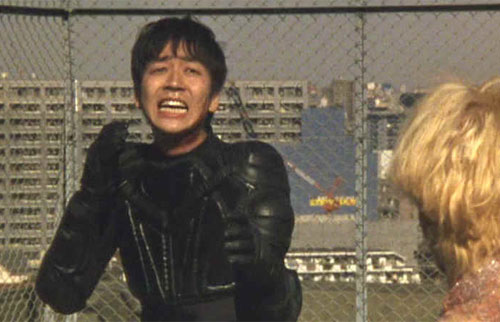
Ichi getting ready to fight Kakihara
Now that I’ve seen Ichi the Killer, I can say that it is my favorite Takashi Miike film. Like my other Miike film reviews (Dead or Alive and Izo, I won’t say too much — mostly because there are so many things happening in the movies that it’s hard to keep track.

For the most part, Ichi is a revenge movie. But more in the vein of Oldboy in that it complicates the “simple” revenge movies we’re used to (plus, like Oldboy there is an element of brainwashing involved). Ichi is conditioned by this guy Jijii to kill people in a pretty gruesome way. In the beginning of the movie he kills the crime boss Anjo, which brings Kakihara into the movie. Although the title of the movie is Ichi the Killer, Kakihara is really the main character.

Kakihara is into torture — seriously into torture. I mean torture like hanging people from hooks and pouring hot cooking oil on them, sticking needles into people’s faces, gnawing the skin off of people’s hands, etc. His methods are so extreme, in fact, that he’s kicked out of the yakuza, which means he has more time to track down his former boss’ killer.

Most of the movie is about Kakihara trying to find out who Ichi is and where to find him. Jijii makes sure that Kakihara is fed lots of false information, so between the two of them, Ichi and Kakihara kill/torture-then-kill a good number of the yakuza gang members (which, I imagine, is Jijii’s ultimate goal — it seems as a kid he witnessed a rape and was unable to save the girl so ever since then he’s had a thing against bullies… also, he plants this memory of the rape into Ichi’s head, so ultimately the rape is also Ichi’s reason for killing bullies — that is, Jijii lives vicariously through Ichi).

There is also the slightly tangential story of one of Kakihara’s thugs, Kaneko, and his son Takeshi. Takeshi is often the victim of bullying, and in the end he sorta becomes the next Ichi. So all around Kaneko’s character there are a bunch of parallels — not just between Takeshi and Ichi, but also between Kaneko and Ichi, Kaneko and a yakuza gang leader, and so on. I actually though that Kaneko’s character was the most interesting and probably the key to the movie.

In the end, there is a climactic-anti-climactic face-off between the two that isn’t as violent as one would expect.

My favorite aspect of the movie was the not-so-subtle sado/masochism theme. Both Ichi and Kakihara were sadists, but in different ways.

Kakihara was a greedy sadist, which made him a bit of a masochist, too — the feelings he got from the S&M behavior were all centered in him. He loved Anjo because Anjo would torture him and make him feel something. Before confronting Ichi, he remarked that he had never felt so anxious but was worried that, ultimately, Ichi would let him down by not causing him enough pain.

Ichi, on the other hand, was a sadist who enjoyed causing pain because he believed that pain made the other person feel good. Right before Ichi kills Karen, she says, “No.” To Ichi, this meant, “You said you don’t want it because you do want it.” It’s the old S&M paradox — to really inflict pain on a masochist, do you withhold pain from them? Or give them what they want? Does “No” mean “no” or “yes”?

I think, like I feel every time I watch a Miike movie, that there is some pretty deep philosophical stuff going on. Unfortunately, I’ve yet to watch any of his films more than once, so I’ve never given myself a chance to wade through it. (The first time I watch, especially since it’s a foreign movie, it’s hard enough following the characters and plot.) Ichi the Killer is definitely worth another viewing.

New Design

I’m not sure how “known” this is, but as far as I am concerned, this blog still isn’t “live” or “official” yet. When I decided to start blogging again back in April, I guess I didn’t make this explicit, but it’s sorta been something I’ve known.

What does this mean? I’m not sure. But I do know that one of the first steps to making Double Reading “official” was to come up with a new and completely different design. So I can now check that off of the list.

I swear, I have been stressing out about the design since I started in April. I have folders upon folders on my hard drive with all my attempts at coming up with something I would be happy with. I learned a lot about Photoshop on the way here, and drew inspiration from a lot of places. Eventually I will get a page (the colophon) that will describe the process a little more in depth.

So where does that leave things as far as becoming “official” and open to the public? Pretty damn close. I want to write up that colophon mentioned above, get some sort of “About Jason” page written up (photos included!), tweak the design a little more (I already see a few things I want to change/improve)… and then it might actually be time.

Please please please give me feedback on the new design. Just don’t say, “It’s too busy.” I intentionally decided to go with a “maximalist” look rather than the trendy minimalist/clean design (though I do think that below the header things are pretty clean).

Serenity Just Now

Serenity logo
(I was joking the other day about how nearly every article I’ve read about the new Joss Whedon movie Serenity somehow incorporates the phrase “serenity now!” in the headline… and now here I am hopping on the bandwagon. Oh well.)

Thanks to Ahe’s mini-review of Serenity earlier in my blog, I’ve been eagerly awaiting the movie’s release. I wasn’t a hardcore-enough fan to go see it opening night, but I did catch it this afternoon, and I must say that I thoroughly loved it.

I am curious, however, about the reaction of people who didn’t watch Firefly the television show. While the movie does, for the most part, stand on its own, as Ahe noted:

… you don’t need to have seen the series to understand what’s going on, although, it does help… especially since two of the characters are basically no longer part of the crew… you understand who they *were* and why they matter.

There are two deaths in the film. One of them was ho-hum for me, but the second one was a pretty big deal. And I’m not sure that the second one would have been a big deal had I not known that person via the television show. (The first character’s death is somewhat expected since that character was pretty minor in the television show, as well.)

Slate had an article the other day, “Joss Whedon: Why he should stick to television,” that I must say I agree with wholeheartedly. Although that headline sorta suggests that the writer (Seth Stevenson) thought Serenity sucked, that’s not the case. Like Ahe’s point above, Stevenson notes that without the emotional background given by the television show, the movie isn’t quite the same.

In one of the last posts on my old website, I wrote about “The Joys of Mythology.” Here are some relevant excerpts:

the deeper and more complex something is, the more rewarding it is to be totally immersed in it… david lynch has said that he loves doing television shows (despite the fact that they always get canceled [see twin peaks, on the air, and hotel room]) because he doesn’t like the two or three hour time you have in films. he likes to create the universe and play there. he likes the stories.

Basically, I wish that filmmakers like Whedon and Lynch would follow Stevenson’s advice and, rather than make films in which they have to cut out a lot of richness, tried pitching some ideas to HBO or something instead of ruthless networks that cancel their shows prematurely and without mercy. As much as I loved the film version of Mulholland Drive, I cannot help but wonder what would’ve happened in the world Lynch created had ABC picked up the pilot. (Back story: Mulholland Drive originally started off as a pilot television show — approximately the first hour-and-a-half/two-hours of the movie. After ABC decided they didn’t want the show, the French company Canal Plus decided to give Lynch the money he needed to finish the film.)

Since it’s too late for shows like Buffy, Angel, and Firefly, I guess the best we can hope for are more movies. Things were left pretty wide open at the end of Serenity, and I am willing to bet that Whedon is already working on a sequel (now let’s hope that the film makes enough money to convince the studios that it’d be a worthwhile investment).

So I would recommend checking out Serenity — even if you haven’t watched Firefly. After seeing the movie I can almost guarantee that you will want to go back and checkout the series on DVD. The two together create an emotionally rich and complex world that is truly worth experiencing.

S-H-A-M-E-L-E-S-S

A Dirty Shame
I’ve been a fan of John Waters ever since my friend Dan sent me a video copy of Desperate Living back when I was in high school. Dan was a huge John Waters fan, and after experiencing the total fucked-up-ness of Desperate Living, I had to see more.

I’m not sure what order I watched things in, but I have since seen Pink Flamingos, Polyester, Serial Mom, Pecker, Cecil B. DeMented, and, now, A Dirty Shame. I guess you could say that ever since the totally grotesque and unbelievable chicken-fucking of Desperate Living, I’ve been addicted.

So as for A Dirty Shame, I’m not going to do a full-fledged Jason-type review. All I can say is that it is great and that, depending on who you are, I recommend it. This film is definitely “John Waters-esque.” For sure more so than his recent movies like Cecil B. DeMented and Pecker. Very disgusting and sexual. And, in a way, somewhat political. I’m not sure how, but Waters totally confronts the anti-sex movement (is there one, though??), but I’m not sure how.

I want to say that A Dirty Shame exposes hypocrisy or something, but I’m not sure it does. If nothing else, it strongly emphasizes the fact that everyone is a sexual creature and that no fetish (i.e. humping strangers’ legs, vomiting on your partner, rubbing food on your “private parts,” getting off on licking dirt, etc.) is too abnormal or strange and that everyone has a little kinkiness in them.

This is, obviously, a very pro-sex movie, but more than that, it’s a pro-sex movie! I mean, more than sex as something to turn people on and get you off, but sex as in a way to get in touch with your inner-self and explore life and all of that. Although there is nudity and “disgusting stuff” in the film, I actually think it’s pretty tame and that its message is pretty simple: Sex is good.

I wish I could say that Walters’s is pushing all sorts of boundaries, but I’m not sure he is. I think I’ve read this in other reviews, but in an age of cinema where sex is as common as condoms, it’s hard to be really artistic and edgy. Sure, A Dirty Shame is way more out-there sexually than Pecker and Cecil B. Demented, but it’s still sorta cute in its message. And not too shocking. Nothing violent, nothing too extreme — just good, ol’ fashioned kinky sex!

Velvet Mourning

Kate Moss
Poor Kate Moss — and I am serious. I do feel bad for her. She was recently featured on the cover of the British tabloid The Daily Mirror doing lines of cocaine. After the image appeared, Moss lost her modeling contracts with numerous agencies, and it appears to be the end of her modeling career.

My interest in Kate Moss started in college when my friend Alicia made a comment about how when it came to models, Kate Moss was the only one she liked. I, of course, didn’t know who Kate Moss was, so we did a Google Images search for Kate Moss and eventually found the picture to the right. I’ve always loved that picture.

Then in summer 2003, one of my favorite bands, Primal Scream released Evil Heat. On Evil Heat Kate Moss joined the band to cover the old Nancy Sinatra/Lee Hazelwood duet, “Some Velvet Morning.” Hearing Kate Moss sing one of my favorite songs only cemented my love of her.

(In addition to Primal Scream covering the song, another one of my favorite bands, Slowdive covered the song on their Souvlaki album. In addition to all of that, Art Bell loves Nancy Sinatra, and “Some Velvet Morning” in particular, and often uses it as bumper music on Coast to Coast AM. The song is beautiful, and I highly recommend finding some version of it and studying up on the Greek mythology surrounding Phaedra.)

Along with the cool picture and her work with Primal Scream, Kate Moss also ushered in that rail-thin, junkie supermodel look, which, as much as I hate to admit it, I really am a huge fan of. I know that these anorexic-looking (and often anorexic) models are extremely dangerous when it comes to perpetuating unrealistic body images and cause all sorts of body image dysmorphia, but I cannot help finding that look attractive. Maybe it has to do with growing up in the ’90s and liking grunge and goth-type music for a long time or maybe there are all sorts of other personal reasons, but nonetheless, I like it… and I admire (???) Kate Moss for starting that trend.

So when she got in trouble the other week, I was a bit sad. But that was about it.

Then Salon.com (as they always do) had a great article about Kate Moss and her legacy that I highly recommend checking out: “The rise and fall of Kate Moss.”

As always, the media (with the exception of places like Salon) are focusing on the fact that drugs ruined Moss’ life and career and that drugs are bad and what is the fashion industry thinking promoting such unrealistic body image types. Yeah yeah. We all know that. But obviously there is something else going on here — otherwise that “heroin chic” would have starved itself years ago. Instead, Kate Moss is even considered “not that thin” compared to contemporary models. I smell some hypocrisy… and so does Rebecca Traister at Salon:

Now, 15 years later, in a set of circumstances that have exposed the hypocrisy and sanctimony of everyone involved, Moss and the fashion industry are becoming accidental and unwilling poster children for a new anti-drug message.

As Traister notes,

News that models do blow is akin to news that rock stars have casual sex: not news at all… The fashion companies’ professions of surprise are hard to believe. Would it be more embarrassing for them to admit they hired a model who they knew had done drugs than it is for them to admit to never having picked up a paper?

So if we know it is such a big deal already — and most of the agencies that she had contracts with could pretty easily assume that Moss was doing drugs often — why is it that when confronted with “proof” we are forced to change our minds. To me, this is an extremely reactive decision — and reactive decisions tend to be made in haste in order to save face rather than really address root issues.

The big hoopla going on in the news, then, is not about Moss’ drug problems, but:

Moss’ real error was in getting caught on tape

Again, the drugs and Moss’ waif, abused body is not of concern to people. Traister rightly points out:

the body that is appealing to designers — and thus to consumers — is a body that looks like it has been ravaged by drugs. In order to stay employed, models must maintain this shape; to maintain the shape they must do something besides eat right and exercise regularly. Whether it’s cocaine or speed or heroin or caffeine or cigarettes or anorexia or bulimia or some combination of the above, most adult women cannot get bodies that look like Moss’ healthily, because hers is not a healthy body.

In addition to Salon.com, Slate also considers Moss’ predicament. In “Kate Moss: The ironies of her downfall,” Amanda Fortini makes similar observations.

Fortini’s more interesting observation demonstrates why people like me seem to be fascinated with Moss:

The irony is that the rumors of bad behavior, the rock ‘n’ roll lifestyle, have always been part of Moss’ allure. For years, the fashion world has courted, and profited from, her edgy, bad-girl image and her gaunt, post-hangover looks.

I’m not sure where all of this leaves us with Kate Moss as a person. She has, essentially, like many women (and it tends to be women — Lyndie England, Terri Schiavo, etc.) who have issues/ideas/criticism projected onto them. It’s like their bodies become empty shells in which the rest of us dump our cultural problems so we can hold these women up as non-human things and deprive them of their personhood.

Now, Kate Moss has become a symbol of the dangers of drug use and the vixen who brought us the trendy emaciated model.

206-415 No More!

I’ve had it with these stupid “me too!!” comments that people are posting on the 206-415-xxxx post. I’ve noted my annoyance before, but now I’m taking action. I have disabled comments for that post. Although it’s fun to get tons of emails with people posting comments, nobody has posted a comment that is worthwhile or interesting in a long time. Censorship? Maybe. But it’s my blog, damnit! Time to take some control!