Category Archives: Movies

The Boring Dahlia

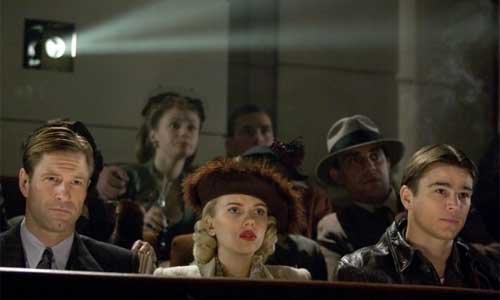
Lee, Kate, and Bucky at the movies
I’m sad to report that I was pretty disappointed with Brian de Palma‘s The Black Dahlia. He’s one of my favorite directors (Femme Fatale is one of my all-time favorite movies and I also love Snake Eyes, Body Double [though I’m not sure it warrants a special edition], Scarface [which has an awesome special edition], and Sisters). People (including myself) say that he’s a Hitchcock rip-off, but that’s not always bad… I also decided to read the James Ellroy novel on which the film version of The Black Dahlia is based. The novel was so-so, but I really expected the movie to be better.

For starters, the color palette for the movie seemed “off” to me. I really expected dark, bold, strong, sexy colors like those from Femme Fatale or David Lynch’s Mulholland Drive. Or even something more stylized and shadowy? Instead, the film felt very brown and drab.

I was also disappointed that de Palma downplayed the psychosexual aspect of the film. Granted, Ellroy’s novel didn’t really tease out the strange threesome-relationship between the three main characters (Josh Hartnett as Bucky, Aaron Eckhart as Lee, and Scarlett Johansson as Kay), but I expected that the film, under the right director, might. The threesome relationship as well as the darker aspects of Bucky’s relationship with Madeline (Hilary Swank), the somewhat doppelganger of Elizabeth Short a.k.a. The Black Dahlia (Mia Kirshner). For some reason I’ve always considered de Palma to be somewhat of a dark and erotic director, but The Black Dahlia reminded me that I apparently confuse him with David Lynch or Adrian Lyne or Paul Verhoeven or something. De Palma is more like a creepy voyeur.

Granted, there were some cool tracking shots (such as right after a woman finds the body of The Black Dahlia) and split-diopter (two objects in focus at the same time) shots, but the film just didn’t feel as viscerally rewarding as some of his other work.

The sad thing is, The Black Dahlia is perfect source material for de Palma. It’s got blonde (Kay) vs. brunette (Elizabeth, Madeline) women, potential doppelgangers (Elizabeth/Madeline, Bucky/Lee), suspense (“Who killed the Black Dahlia??”), allusions to film (The Man Who Laughs and the Hollywood setting), etc.

I’m not sure whether de Palma really has become “a director for hire” or what. I hope that Femme Fatale wasn’t his apogee and now he’s all downhill.

Fall 2006 Here I Come

Every few months I end up posting a sort of “calendar” of events/things that I am looking forward too (it seems that last fall was good, too). Eventually I do intend to write or find some sort of WordPress plugin that makes this easier and less table/post-ish, but there are just so many things on the horizon that I cannot wait… As always, let me know if you wanna join for concerts or want information on any of this stuff. (Note: I get CD release dates from Metacritic’s Upcoming Releases, I get DVD release dates from Joblo’s DVD Release Dates Schedule and Cover Art, and I get movie release dates from Entertainment Weekly‘s Coming Soon.)

Month Day Exciting Thing
August 22 Paris Hilton by Paris Hilton (I’m already preparing to be thoroughly embarassed when I buy this), Kelis Was Here by Kelis, Idlewild by OutKast, Classics by Ratatat
August 29 Arrested Development season 3, Desperate Housewives season 2, Nip/Tuck season 3
September 5 B-Day by Beyonce (CD), Dreams by Whitest Boy Alive (Erlend Oye’s [Kings of Convienience] new band), Lost season 2
September 8 Dandy Warhols at the Showbox (buy tickets)
September 12 Crazy Itch Radio by Basement Jaxx, The Outsider by DJ Shadow, So This Is Goodbye by the Junior Boys, Pieces of People We Love by the Rapture, FutureSex/LoveSounds by Justin Timberlake, Return to Cookie Mountain by TV On The Radio
September 15 The Black Dhalia opens in theatres (new film by Brian De Palma; I am about to start reading the book)
September 19 Battlestar Galactica season 2, part 2
September 24 Season 3 of Desperate Housewives begins
September 26 Ta-Dah! by the Scissor Sisters, Lady Vengence (part of the triology that includes Old Boy and Sympathy for Mr. Vengence), The Presets at Chop Suey (buy tickets)
October 3 The Information by Beck, Sam’s Town by the Killers, Scissor Sisters at the Showbox (buy tickets)
October 4 Season 3 of Lost begins, Shortbus opens in theatres
October 6 Season 3 of Battlestar Galactica begins, The Departed opens in theatres (Martin Scorsesse’s remake Infernal Affairs)
October 13 Ladytron at the Showbox (buy tickets)
October 20 Fast Food Nation opens in theatres, Marie Antionette opens in theatres
October 24 The L-Word season 3
October 26 Placebo at the Showbox (buy tickets)
October 27 Babel opens in theatres
November 3 Volver opens in theatres
November 14 Hot Chip at Neumos

Looks like there is a lot to look forward to! If you have any additional recommendations, please let me know.

The Devil Wears a Superman Costume

For the first time ever in my life (I’m 90 percent sure, at least), I saw the top two weekend movies. I saw Superman Returns on Wednesday night and The Devil Wears Prada on Saturday afternoon. Am I falling deeper and deeper into the sell-out/becoming mainstream pit?

20 Centimeters

20 Centimeters
From the description on the SIFF web site, I was very excited to see 20 Centimeters:

Reminiscent of the Almodovar style and grounded by an amazing performance by Mónica Cervera, this bittersweet musical comedy is about a narcoleptic transvestite prostitute who longs to rid herself of the 20 centimeters hanging between her legs. She finds a refuge in her dreams where she is transformed into a seductive song-and-dance sensation.

Almodovar! Narcoleptic! Transvestite! Sounded great to me!

… Unfortunately, it wasn’t. The film didn’t have the smartness that an Almodovar movie has, and I felt like the narcolepsy and transvestitism (and for that matter, the “dwarf” best friend) were there for “freak factor” more than anything else. (Not to say that transvestitism wasn’t a main theme of the movie, but still…)

The only thing this film had going for it, as far as I’m concerned, was the musical numbers. And of those, the only one that really sticks in my mind is the dream sequence involving Madonna’s song “True Blue.” It envisioned what married life would be like — babies, horny/cheating husbands, funerals, etc. The sequence was great, and I almost recommend seeing the movie just for that.

Otherwise, the film follows Marieta, a woman who has a 20 centimeter (i.e. 7.8 inch) dick, which she wants to get rid of. She works as a prostitute but eventually gets a job as a man (since that was on her identification card) doing janitorial work. Along the way she meets a hunk of a guy who loves her for her penis and loves to bottom out for her even more. Things don’t work out with him, however, since he is too passive for her.

Like I said, this movie really didn’t impress me and I gave it only two stars. I would’ve given it one, but the “True Blue” part was so entertaining that I felt that aspect of the film needed to be rewarded.

Destricted

The fact that I cannot really post a picture from the movie Destricted should be the first sign that this is the most sexually explicit film I’ve seen (more so than 9 Songs, even). I don’t think you could see a movie with more penises unless you were watching porn (and this film definitely borders on pornography).

The idea behind Destricted is that seven contemporary artists are given a chance to make short films about “sex and pornography.” Each film, of course, somehow captures that artist’s unique style and perspective. Here are my quick and dirty (no pun intended?) thoughts on each:

“Hoist” by Matthew Barney — I haven’t seen any of Barney’s other films (such as The CREMASTER CYCLE or Drawing Restraint). The only reason I really recognized his name is because he is married to Bjork. I have to say, “Hoist” was pretty damn avant-garde. The film was basically a man (or something of a man — he was sort of half-nature/half-man or something like that) masturbating and using his cum to lube up a big drill or something. It was sort of funny that the film started with “Hoist” since it was definitely the most abstract of the pieces. I know I was thinking to myself, “Oh great, what have I gotten myself into this time? Is Destricted going to be even more abstract and difficult than Container???” As for the meaning from “Hoist,” I didn’t really get much. I figure it had something to do with industrialism and the environment (hence the nature man thing), but who knows for sure.

“House Call” — I’m not quite sure what exactly was going on with this film. To me, it looked like the camera was zooming in on a 1970s porn movie about a woman and a doctor having sex. The zooming-in effect was cool, but, again, I’m not sure whether we were supposed to see/feel something different. I’m not even sure whether the film was a porn film from the 1970s or a remake to look vintage or what. I wasn’t really a fan of this film.

“Impaled” — Directed by Larry Clark (who did Kids and Bully), “Impaled” was easily the best film of Destricted. The film started with Clark interviewing straight guys between the ages of 18 and 25 or so about pornography and sex. He asked them about their experience with women, what sort of sexual acts they liked to do, how long they have watched porn, etc. At one point he even had the guys remove their pants and show their dicks and discuss why or why they didn’t shave/trim their pubic hair. (Most of the guys did trim and said they did it because the guys in porn films did the same.) Apparently Clark was interviewing the guys because they had answered an ad he posted on the internet offering guys a chance to fuck a porn star.

Once Clark choose one of the guys (a moderately attractive guy from Southern California who really wanted to try anal sex), Clark and the guy interviewed the various porn stars to see who had the best chemistry with the guy. It was funny to see how uncomfortable the guy was around most of the porn stars that were obviously more experienced and somewhat intimidating. He asked various questions such as: When did you start making films? When did you lose your virginity? Why do you like the industry? etc. One of the more poignant answers was from a woman who had just gotten out of a five-year relationship with a woman. The guy asked when she lost her virginity, and it was something having to do with being raped by a relative when she was a little girl. The guy was obviously asking this question to get some steamy fantasies going, and her answer hit him like a ton of bricks.

Ultimately, he chooses a 40-something because he said he liked older women, she loved anal, and she was totally flirtatious with him. The sex scene was pretty straightforward. They made out, she gave him head, etc. I was surprised that he could get hard for the shoot considering it could’ve been a pretty awkward situation. I was doubly surprised that they didn’t use condoms for the sex. It seems like a lawsuit waiting to happen (a young guy having sex with a woman who has been in the porn industry for quite a long time…), but I would imagine/hope everyone was tested prior to interviews. The best part, however, was when the guy got his anal sex fantasy fulfilled. After fucking for a while, he pulled out to find that his sick was covered with shit. He was somewhat grossed out so the woman went to get some baby wipes to clean it off and wipe her ass. She apologized and after he got hard again, they kept on going. At the end of it all, the guy didn’t really have any profound thoughts. He said the anal was nastier than he thought it would be and that shit in the ass was the kinda stuff you didn’t really think about when you fantasized (no, really?).

What I loved about “Impaled” was the way Clark managed to tease out how much pornography has influenced people’s lives nowadays. It’s so accessible that pretty much every guy has seen it — and has had his ideas of sex influenced by it, as well. “Impaled” really struck down the fantasy that pornography creates and presented it as real, messy (literally!), sex.

“Sync” — This was a 1-minute super-fast editing job that took various sex scenes from movies and placed them together as one continuous collage-like film. What really impressed me about the movie was that I learned during This Film Is Not Yet Rated that when it came to sex scenes in movies, the MPAA was really critical about what types of positions could be shown and for how long, etc. Hence, the “man laying down with woman riding her” and “woman laying on her back with man fucking her while propped up on his elbows,” etc. positions are so common in movies. “Sync” really emphasized how all the sexual positions in movies are just the same.

“Death Valley” — Nearly eight minutes of a fairly hot guy masturbating in the desert but is ultimately unable to cum. That is what “Death Valley” was. But despite the terse description, this short was actually really well done. Matmos did the music, though I still feel like they sampled or ripped-off some other song I know. But the film is, obviously, about male impotence or something like that. I did enjoy it.

“Balkan Erotic Epic” — I thought this short was funny at times, but also stupid at times. Overall, I think the stupid outweighed the funny and I wasn’t impressed. The point of the film seemed to be to show how sexuality was a common part of everyday Balkan life. This included traditions like men masturbating on fields, women putting fish in their vagina for a day then grinding up the fish and feeding it to their husbands, etc. I’m not sure if these traditions were real or not, but I don’t necessarily think that’s the point. To me they just seemed old fashioned and sexist.

“We Fuck Alone” — I would imagine that most people in the audience would’ve rated this movie as their least favorite. Of course, I sort of liked it. “We Fuck Alone” followed two people (a guy and a girl) who were masturbating to pornography. This went on for about 20 minutes and was accompanied by a strobe effect (and I love strobes) and a noisy soundtrack. The woman used stuffed animals as a prop. The guy used a blow-up sex doll as a prop. At one point the guy shoved a gun into the doll’s face (which may have been too blatant and cliché?). What I thought was interesting about the film was the idea that “we fuck alone” in the sense that pornography has replaced human sexual contact for people so much of the time. Is this good or bad? I’m still not sure, but “We Fuck Alone” gave me quite a bit of time to ponder it.

3 Needles

Chloë Sevigny in 3 Needles
Keep in mind that the title of this film is 3 Needles and that the movie is about HIV. It seems that in most movies I’ve seen that deal with HIV (with the exception of Trainspotting), the person becomes HIV+ by having unprotected sex or blood transfusions (if it’s a straight person) or something like that. It also seems that whenever HIV is discussed in relation to the “developing nations,” one always assumes that HIV is contracted via sex and/or circumcision/genital mutilation. Sure, all of those issues are addressed in 3 Needles, but needles remain the symbolic object-of-fear.

3 Needles is broken into three stories: one story about an HIV outbreak in a small village in China, one story about a porn actor who has HIV and his mother’s attempt to identify with him, and one story about nuns trying to save the souls of people with HIV in South Africa.

The first story is a little confusing at first. It opens with a woman (Lucy Liu driving a van down a dirt road. She is stopped by a group of guys dressed in military clothes. She claims that she is transporting rape seeds. The soldiers demand that they inspect her cargo. Finally they remove a box that looks like a casket. They ask what is in it; she insists that it is just rape seeds. The commander tells the soldiers to shoot it to “give it some air.” Blood spills out. At this point, I think the audience is supposed to believe that she is smuggling a person for some reason or another. When the soldiers open the box, however, bags of blood spill out.

We then learn, though a flashback, that the woman’s job is to set up blood collection camps in small villages. The story then starts following a man named Tong (Tanabadee Chokpikultong). Tong takes his wife and daughter to the blood collection center so that they can get more money. Tong, however, has the flu and since he appears sick, the people at the blood center refuse to take his blood. They also refuse to take his daughter’s blood since she has not yet turned twelve.

A week later (the center allows people to donate blood every week) they still do not let Tong give his blood. He does, however, convince them to take his daughter’s blood, joking with them that she is now twelve.

Tong uses the daughter from his daughter’s blood donation to buy a water buffalo (which she gets to claim is hers). The next time Tong and his daughter go to give blood, the man still refuses to take Tong’s blood, but he does give him a job to deliver the bags of blood to the woman in the van’s house. When he arrives there, he sees that everyone is sick, but makes the delivery anyway.

Shortly thereafter, the daughter becomes sick, as does Tong’s wife. We see that other villagers are sick, too. Not much time passes before Tong’s entire family is dead.

After the provincial authorities refuse to investigate the incident, Tong goes to a larger governmental office. There, he convinces them that they need to find out what happened and they return to Tong’s small village. It doesn’t take much time for the doctors to realize that everyone has become infected with HIV. Tong explains to the commander (from earlier) that the woman in the van set up a blood donation center.

At the end of the first part, the soldiers help the family-less Tong harvest his rice, which Tong shares with the rest of the sick villagers since they are unable to produce food on their own.

The second story is, by far, the darkest. It starts off with a young man in his early 20s (Shawn Ashmore) taking a sample of blood from his sick and dying father. Then we see him on the scene of a porn film saying it’s okay if he doesn’t use a rubber since he was just tested. I think it’s worthwhile to note that he is straight and acting in a straight porn film (that surprised me). On the day of his next HIV test he runs into a crying girl as he enters the clinic — it turns out he’s acted with her before, and now she is HIV+.

Ultimately, of course, others become infected and his father dies and the doctors confirm that he, too, is HIV+. His family doesn’t have much money, and with the recent loss of her husband, the actor’s mother (Stockard Channing) doesn’t know what to do. She goes to a support group and overhears a gay guy talk about how he was always afraid and feeling anxious about acquiring HIV, so he goes out and intentionally meets guys who will infect him (which is called “chasing”).

It seems that this gives the mother an idea and she goes and takes out a life insurance policy. She has a physical to prove that she is healthy, and then goes to stand outside one of the HIV support groups. She meets a guy there who she brings to a strip club, gets drunk, and seduces. When they are about to have sex, he insists that they use a condom. She hesitates, and then bites it so that it’s ineffective. He fucks her. She gets tested. She is still HIV-.

Discouraged by her failed attempt, she starts going through her son’s stuff. She finds the needle that he used to use to extract blood from his father (so that he could fake the test). That night, while he is sleeping, she takes a sample of his blood. In a scene that definitely had everyone in the theatre cringing, she even licks some of the leftover blood off of his arm after she removes the needle. More than shocking or disgusting, I found the scene to be extremely emotional and sad.

Presumably by injecting herself with his blood, at her next visit to the doctor she is informed that she is indeed HIV+. She cashes out the life insurance, and she and her son live a life of luxury. In the very last scene of their vignette, the actor and his mother run into one of the porn actresses who he infected. She accosts him for doing what he did (knowingly infect others, or, at the very least, not take a truthful HIV test) and seems to imply that what he did should be illegal.

If the second story is the darkest, then the third story is the most controversial. It follows three nuns (Olympia Dukakis, Sandra Oh, and Chloë Sevigny) who go to South Africa in order to save the souls of people with HIV so that they don’t go to hell but go to purgatory or heaven instead.

The plot for part three is a little more complicated and has more characters, so rather than summarize it, I wish to comment on the rather harsh critique of Christianity.

One of the commonly-held myths in Africa is that if a person who has HIV has sex with a virgin, the virus is passed on to the virgin and the person with HIV is cured. Of course, the presence of Catholic missionaries in Africa who promote abstinence until marriage (i.e. preserve virginity) and condemn the use of birth control/contraception only exacerbates the problem… but 3 Needles goes a step farther and draws a parallel between the Virgin Mary and HIV.

The idea goes like this: God took the sins of humanity and put them into the Virgin Mary so that she could have Jesus in order to repent those sins. Likewise, the African myth that if you put sin qua HIV into someone, that sin qua HIV will transfer into that other body, which can then be redeemed. At the end of part three, one of the nuns is raped. She says something to the effect of, “How can I blame him? I spend my nights praying to a virgin, too.”

I, for one, thought that this was a rather bold statement. If I’m reading the film correctly, the filmmakers are possibly saying that those who criticize the efforts of people in Africa to “denounce the myth” but at the same time believe in a similar Christian myth are being hypocrites. It’s not that the logical argument in either situation makes sense, but the structure of the argument/idea is the same. And in both situations, the fetishizing of virginity has harmful consequences.

As for the appearance of a needle in the third story, toward the end one of the nuns follows some kids who collected the green biohazard disposal container from the landfill. The kids take the container to the back of a bar, where the nun sees the kids cleaning the needles with a towel then repackaging the needles. It turns out that all of the needles that the doctors had been using to test the people were in fact dirty contaminated needles in the first place, and that the doctors may in fact be infecting the very people they are trying to test/save.

What I really liked about this movie was that it definitely took great lengths to de-stigmatize an HIV infection. Rather than suggesting that HIV is the result of overindulgent behavior (promiscuous sex, drug use, etc.), HIV in fact is more of a result of human desperation and greed at the hands of others.

At the closing of the movie, one of the nuns makes a comment along the lines of, “When humans have this great enemy why can’t we band together to fight it? Well, I think it’s you, God, who prevents us. Or, at least, the ways people believe in you.” The film depicts how a blind faith in Buddha, Christian God, and African mythology are very dangerous beliefs that perpetuate the spread of HIV in various communities.

I gave the movie four starts. It could very easily have been a five-star movie, but the first story was confusing at first and the second part felt too short while the third part felt too long.
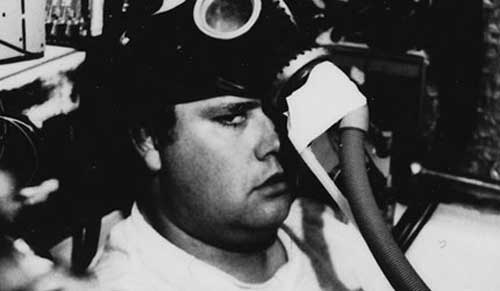
Container

Container
Last year’s SIFF film A Hole In My Heart has haunted me more than any of the films last year. I regret only giving it three stars. Although the movie was very fucked up and probably exploitative, it was a great work of filmmaking and definitely deserved five stars.

Unfortunately, I don’t think Container, Lukas Moodysson’s latest film to play at SIFF, will stick with me the same way. But I could be wrong. I gave this movie an even lower rating — just two stars.

I have a bad feeling that I’ve said/written this before, but I honestly think that Container is the most abstract/”artistic” movie I’ve ever seen. There was no discernable plot to the film. There was no music or sound effects (well, until the end when a droning industrial noise a la David Lynch entered the film).

As far as I could tell, it was basically a narrator (Jena Malone of all people!!) reading some sort of a poem written in the first person. The topics of the poem ranged from information gleaned from gossip columns to ruminations on the pregnancy of Mary to dreams of Kylie Minogue (with a nice ass) representing the angel Daniel to collecting boots from a porn actress named Savannah.

The visual images that accompanied the narration synched up with the topic of the text sometimes, but more often than not followed a fat guy (who, I think it’s safe to say, wrote the text that the narrator is reading) doing strange things like taping baby dolls to his face, taking bathes with ravioli, and cross-dressing by wearing a blonde wig and makeup. At times the man is accompanied by an Asian girl (who often rides on his back).

If I had to say (and I’m pretending that I do have to) that there was a theme to the film, I’ll go with my old psychoanalytic favorite: abjection. I really do mean it, though. I think it’d be a fairly straight-forward and obvious reading of the film to suggest that the Asian girl was in fact the “inner girl” that the fat man talked about a few times and tried to express with his cross-dressing. He hated the fact she was inside of him and was not “outside of” him i.e. that his outside was a man and not a woman.

In addition to that basic thematic reading, the visual aspects of the film often focused on garbage and fetuses. Not to be “pro-abortion,” but I think it’d be pretty easy to say that fetuses could be a clear signifier of a desire to abject something. Further, the narrator once said something like, “Stop kicking me or I will get an abortion.”

What this all means, I don’t know. As of right now (less than two hours after leaving the film), I’m left with nothing profound. After A Hole In My Heart I remember feeling sorta dirty and confused — but the film stayed with me. Part of me doubts that Container will have that same affect.

One final note that isn’t about the film: Container was shown at the Northwest Film Forum. The venue was very small. I think about twelve people left during this movie — way more people than during A Hole In My Heart. I think I’ve written this before, but I’ve never left during a movie. I think it’s rude and I think that people should know what they are getting into beforehand. But during Container, it seemed that people who left wanted to make it known that they were leaving. Maybe it was because the place was small and had wooden floors, but it sounded like people were stomping out and trying extra hard to be loud. It was irritating.

Screaming Masterpieces

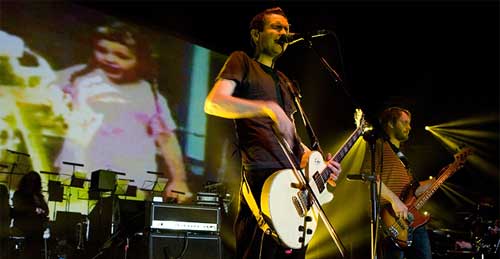
Sigur Ros live
I’ve been thinking that Iceland is “the next big thing” for music for quite a few years now. After Sigur Ros proved that Bjork wasn’t the only musical genius hailing from the island country, it seemed pretty obvious that something was going on with the music scene in Iceland.

Screaming Masterpieces (or is it “Masterpiece” singular — SIFF seems to have the name wrong?) starts with the same premise. It’s somewhat of a “Who’s Who” of the Icelandic music scene. Bjork is definitely covered (and interviewed) pretty extensively — which makes sense, since she is probably the most famous musician to come from Iceland.

The documentary also gives us some insight into other Icelandic bands such as Johann Johannsson, Mum, Bang Gang, Apparat Organ Quartet, Slowblow, The Sugarcubes, Ghostigital, Mugison, Amina, Minus, and a few others. (I found that list of artists from the Screaming Masterpiece soundtrack web page. After hearing some of these bands perform in the film, I am definitely going to find out more about Bang Gang, Apparat Organ Quartet, Ghostigital, and Amina. As for Mum, it’s kinda funny that they were in the film since I’ve been looking for their remix of Goldfrapp’s “You Never Know” from one of the “Fly Me Away” singles.

One thing the film definitely confirmed for me about Icelandic music is that it’s very majestic, intense, and ethereal. Even the heavy metal and punk bands created beautiful noise (at least, more so than their American and European counterparts). A bunch of the musicians also commented on the role that the landscape plays in their music. Granted, I haven’t been to Iceland, but pictures of it are pretty amazing, and I can totally understand how the mountains, the ocean, the sky, the northern lights, etc. would encourage one to make such beautiful sounds.

Although Screaming Masterpieces managed to cover a pretty wide variety of musical styles, I was surprised that the electronic group Gus Gus wasn’t included in the film. Their song “Ladyshave” was pretty popular and they’ve released three albums, so I’m fairly sure they are not some totally obscure group. Also, one of the members of one of the bands in the film noted that a sense of family and collaboration was one of the main defining characteristics of Icelandic music. Gus Gus, from what I understand, is something of an artists troupe, so it seems to me that they exemplify this perfectly. Oh well.

Ultimately, it seems to me that the main reason music from Iceland is so interesting and unique is the fact that the population is fairly small. Not even 300,000 live in the country. As one guy explained, if you are a small band you might hope to sell 200 albums or so. You can’t make much money from 200 albums, so rather than trying to make something marketable and whatnot, you just go ahead and make whatever sounds good to you. And for whatever reason, “whatever sounds good to you” in Iceland is better than anywhere in the world?

(As a final side note, I also learned that most of the people who live in Iceland don’t consider it to be part of Scandinavia. I’m debated whether I should edit the Scandinavian playlist on my iPod by removing Bjork, Gus Gus, etc. For now, I’m going to keep it there…)

This Film Is Not Yet Rated

I’m glad to say that I’ve started SIFF off on a good note. And very apropos, my first film this year was a film about films: This Film Is Not Yet Rated by Kirby Dick.

Basically, This Film is a documentary about the MPAA and it’s often-criticized ratings system. Toward the end, the film delved into a meta-film state where Dick went through the process of having the film rated by the MPAA then go through the appeals process.

Like any good documentary, This Film contained lots of funny stuff (clips from overly sexual movies, witty comments, lesbian private investigators in Los Angeles), commentary from famous people — both intellects (Lawrence Lessig, various academics) and film types (John Waters, Mary Harron, Maria Bello, etc.), and some really probing questions about the subject matter (Why are the members of the ratings board kept anonymous? What is an “average” American parent? Why is violence allowed more often than sex?, etc.)

The film started with the basic question: Why does nobody know who is on the board of people who gives films rating for the MPAA and what qualifications do they have when it comes to rating movies? It turns out that the eight members are kept anonymous so that they are not influenced by the studios (despite the fact that, according to the film, they often consult for a movie after viewing it).

The filmmaker ends up interviewing various private investigators in an attempt to discover who is on the board. He ultimately chooses a lesbian couple who claim that they will do whatever it takes to get the information needed. “Whatever it takes” turned out to be sitting outside the MPAA, finding out who goes to lunch when, tracking down some license plate numbers, making vague but information collecting phone calls to the MPAA office, and tracking down people at restaurants. With the PIs help, Dick is able to give us the MPAA Ratings Board Class of 2005. It turns out that many of them have children well over the age of 20, which begs the question: Why should they be the ones rating films?

This Film also delves into the obviously biased method in which films are rated. Of note: gay and lesbian films get NC-17 ratings for things that easily make it into R-rated straight films (e.g. But I’m a Cheerleader vs. American Pie), violence is not as much of a problem as sex (e.g. dismemberment in Sin City vs. a Maria Bello’s pubic hair in The Cooler), if a film has violence no blood must be shown (e.g. bloodless PG-13 Tomorrow Never Dies vs. bloody R-rated Saving Private Ryan), and military the military should be shown in a positive manner (e.g. realistic Gunner Palace vs. Top Gun).

The audience for this film was great. The Egyptian was totally packed (I forgot that you often have to wait in line for SIFF films, and this line was wrapping way around over toward QFC) and the crowd was totally into it. I’m one of those people who hates it when people clap and cheer during movies, but This Film and the audience had me clapping and laughing and cheering more than any movie I’ve ever seen. The energy of the film is great and really keeps people engaged with what could potentially be dry material.

Following the film we were lucky enough to have Kirby Dick take some questions and give some answers, but I didn’t realize he would be there and didn’t plan accordingly by bringing a notebook to jot things down. The jist of a lot of the questions, though, were along the lines of “What next?” and “What does this all mean?” It seemed pretty obvious that leading up to the film’s theatrical release in September there is probably going to be some sort of grassroots anti-MPAA/ratings movement. We’ll see what pans out.

I gave this movie an “enthusiastic” 5 and I don’t think it’s just because it’s my first SIFF film this year and I was excited. This was a truly great movie and I highly recommend it.

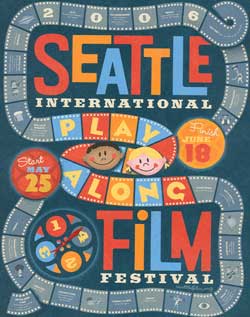
Play Along

2006 SIFF program cover
Just the other night Seattle International Film Festival (SIFF) 2006 had its kick-off gala. The opening film was The Illusionist. I didn’t go.

But I did end up buying a bunch of tickets for other films. Here is my list, join me if you can!

I will admit, despite the fact that I am seeing more movies this year, I’m not as excited about the lineup as I was last year. I chalk some of this up to the fact that last year was my first SIFF so this year it’s not as new and exciting, but at the same time, there aren’t movies by directors that I absolutely love (like 2046 or Mysterious Skin). But who knows, I’m hoping that I’ll be pleasantly surprised.

Watch my blog for reviews (I’ll try to get them up as soon as I can after each film) and feel free to join me and/or comment on all the reviews.