You Can’t Take the Sky From Me

It’s no secret that I’m a huge Buffy and Angel fan. That said, I don’t really fall into that category of fan who thinks that Joss Whedon is the smartest and most talented man in the world. Yea, I love Buffy and Angel and I am one of the few people who don’t hate Alien: Resurrection, but whatever.

That said, I decided to pretend being a Whedon obsessee by purchasing his short-lived televsion show Firefly the other week.

It took me a while to get into the series — and I’m still about six or so episodes from finishing it — but now that I’ve had time to really get to know the characters and whatnot, I gotta say that it’s pretty damn good.

Specifically, the back-to-back (but unrelated) episodes “Out of Gas” and “Ariel” are some of the finest ever.

I loved how “Out of Gas” showed how Mal met all of the crew members… it’s always nice to see backstory, so I was a fan of seeing how people ended up on Serenity. I also loved the three narrative threads: one showing past (meeting the crew), one showing present (how the ship became damaged and why people left), and future (Mal attempting to fix Sereneity). It was both suspenseful and informational.

As for “Ariel,” I can’t really say why I loved it without giving much away — and I don’t want to give anything away. That said, let me just say that the ending (the last three minutes) really disappointed me. Oh well. I’m curious to see how the events of “Ariel” change things going forward.

It’s All Lies!

J and Y having sex
I’ve watched some pretty sexual, taboo-breaking movies in my day (The Dreamers, In the Realm of the Senses, Visitor Q, etc.), so I would say that I’m pretty used to explicit and strange sex on film. Now I can add Lies (Korean title: Gojitmal) to my list of sexually-intense movies.

I would also add that all of these movies (in addition to tamer American ones such as 9 1/2 Weeks and Secretary to the list) seem to have the same moral message: If sex becomes the primary focus of your life and you forget about things such as your job and friends, only trouble will come. In the end, it is impossible to sustain a hyper-passionate physical relationship with someone… So while these movies may seem subversive and whatnot on the outside, I think that they ultimately suggest a more conservative message and theme.

That said, on to Lies:

This movie was based on (what is, as far as I can tell) an autobiographical story that takes place in South Korea and is about two lovers involved in an sado-masochistic relationship. The man, J, is 38 years old and married (though his wife is a non-character, as she is off-screen in Paris all the time — except for J’s infrequent visits to her). The woman, Y, is an 18 year old school girl.

The film opens with the director telling (in a documentary-like format) that the film is based on a story and that he wanted to make it into a movie — or something like that. When I first saw this part, I wasn’t sure if it was a making-of before the film started or whether it was part of the movie or a disclaimer. To be honest, it made me uncomfortable — a perfect setup for a movie like Lies.

Y meets J because Y’s friend Woori somehow knows J (it’s never clear how they met, though it is clear that they didn’t have sex). Y speaks to J on the phone and is so enamored by his voice that she tells him that she wants to fuck him. She then takes the train to wherever he lives and they awkwardly meet.

Again, the film cuts-away to a documentary-styled interview with either Y or the actress who plays Y. An off-screen male voice asks her how she feels about doing the film. She says that she doesn’t like to be naked. She also says that regardless of her fears, she will go ahead with the movie because she doesn’t want to let the crew down and ruin the movie.

Then the interview ends and we return to the film.

Back in the motel room, J and Y begin to have sex. When they first kiss, it’s somewhat disgusting and juvenile. J uses way too much tongue and Y obviously doesn’t know what she’s doing (as a virgin, I’m guessing she hasn’t ever kissed, either?) — or maybe they are both uncomfortable? They make it over to the bed quickly. J asks Y if she is sure that she wants to do this, and she says yes — he is making her feel good.

The first time they have sex, he penetrates three holes: first her vagina, then her mouth, and finally her asshole. The sex during the first encounter is the most explicit in the film. There is no background music. All we see and hear is them having sex. He licks her body, he eats her pussy, he licks her ass — we see it all. We even see his penis, which is pretty rare for any movie containing nudity — and we see it often. His penis isn’t present in one dominating and dramatic shot (like penises usually are when they appear in film), but it’s soft and very typical looking. I was, obviously, surprised by this.

Also, at one point during the sex scene, while J is licking Y’s armpit (and he tells her that it doesn’t smell), there is a strange self-aware moment where the director (or someone) says to J: “She doesn’t smell, like the devil. Maybe she is the devil?” The whole thing was very weird, and isn’t really addressed anywhere else in the film. It’s worth mentioning and noticing, though, because I do think that one of the goals of the film was to blur the boundaries between art film, pornographic film, and documentary.

Following the sex, there is an “interview” where J asks Y why she wanted to have sex with him. Her answer was maybe one of the most shocking parts of the movie: she explains that both of her sisters lost their virginity through rape. She reasoned that she didn’t want to lose her virginity by rape, so she would choose her first sexual partner. Wow. Just the reality of thinking that way struck me. What an awful way to decide to have sex for the first time.

After their first encounter, Y returns home and is beat-up by her friend Woori, who is very jealous. Eventually they make up, and Y tells Woori all of the explicit details of her sexual encounter with J.

So turned on by their first meeting, J and Y continue meeting. Eventually, during one of the times J is fucking her up the ass, he slaps her. The narrator (who is sometimes J and sometimes the director [I think?]) notes that J used to slap his wife until she said she had enough of it and moved to Paris. Unlike J’s wife, however, Y seems to take pleasure from J’s slaps.

The slaps quickly escalate to whipping and flagellation. Originally, J always takes the sadist role and Y takes the masochistic one. I guess you could say that the pain inflicted during the sex escalates. Y has some pretty nasty cuts and scars on her ass and thighs. We also learn that J used to whip his wife and ultimately wanted to turn her into a sculpture basically. That is when she left for Paris.

Although their relationship starts with Y always taking the masochistic role, the tables turn and J is eventually the one getting whipped by Y. The switch is prompted by Y making a comment that she doesn’t take pleasure from the whipping, per say, but rather in the fact that it gives J pleasure — giving him pleasure gives her pleasure. When Y whips J, however, it is obvious that receiving the pain gives him pleasure — not the fact that Y enjoys giving him pain.

Their sexual exploits continue until J has to return to Paris to visit his wife. When he returns three months later, Y reveals that while he was away she gave another man a blowjob. When he gets angry, she argues that she missed his cock and that he was fucking his wife anyway so why could he have sex and she couldn’t? Finally, she suggests that he should punish her for her transgressions.

The scene that follows is, I think, the most violent and difficult to watch scene of the film. When she bends over to receive a whipping, J slaps her in a very non-sensual way (yes, there is a difference). He is taking out his anger and frustration — not trying to enjoy pleasure or give her pleasure. Y is privy to this fact. She cries out and falls over and tries to block the whipping with her hands. He continues to beat her despite her pleas for him to stop and her cries of pain.

After beating her, J proceeds to rape her anally. When she begs that he stops and warns that she needs to take a shit, he continues anyway. As warned, she defecates while he’s fucking her. He takes his dick out and tells her to suck it and clean it off. She hesitates, but obliges, fearful, I’m sure, by his new turn toward violence. After giving a blowjob to his shit-cover cock, J tells her not to swallow and to kiss her. A narrator’s voiceover tells us that he (J) realized why shit was disgusting: it didn’t have a taste (sweet, spicy, salty, bitter, etc.).

The next scene finds J and Y in a subway acting flirtatious and lovey with each other again. Y tells J that she now realizes that he truly loves her. In what has to be one of the best lines ever, she says: “I know now you really love me. Who else would eat my shit?” (or something to that effect). So ask yourself, if someone tells you that they love you, can you really be sure until they eat your shit?

From that point on, basically, J and Y tumble into a life of nonstop sex. J looses his house and spends all of his money paying for places for him and Y to fuck. Y drops out of school and abandons her family. The two of them live only to have sex with each other — nothing else matters.

This path, as I mentioned early in this review, is not sustainable, and ultimately things don’t really work out. I won’t go into too much detail since it’s interesting to see what happens (and, really, from the beginning you must know that they can’t spend the rest of their lives fucking without abandon). I will say, however, that the end, for me, was pretty disappointing. In the last scene we find out what the title of the film, Lies, refers to, and it isn’t deep or profound or very meaningful.

Overall, I think Lies is worth watching because it’s so shocking. The first sex scene is like nothing I’ve seen in contemporary film — it is explicit and awkward: not sexy at all. There are also a few intertextual moments (like the interview of the actress playing Y and the director and the “The devil doesn’t smell” comment) that really force the audience to ask whether the movie is exploitative or what.


Who Really Loves Me?

Wong Kar-Wai DVD Collection
So, who really loves me and wants to buy me The Wong Kar-Wai Collection??? Although the retail price is $76.96, it looks like you can find it used on amazon for under $70. I will love you forever and forever.

For real, though, I have to buy this. It contains the following movies:

Although I already own Happy Together, I think it’s worth doubling my efforts in this case. I can give it away as a present or something sometime in the future.

Also, as a bonus, if you really really really love me, you can throw in In the Mood For Love – The Criterion Edition. I want that too.

Presence of an Absence

More might come on this later, but this morning I was reading about the idea of the “presence of an absence” (in the Lost Highway section of Pervert in the Pulpit), which the author seemed to attribute to Hegel. I was reminded that this is one of my all-time favorite ideas, right up there with “double reading” and projection. I’m sure there are others. Maybe sometime in the future I can devote an entry to my favorite theories — and even explain what they mean, which I’m not going to do now, either.

Blast From the Past?

Out of Control -- my old web site
I’m debating whether I should try to take some of the posts from my old website and migrate them to this site. I realize that there are a few really good posts saved there that might be worth saving and sharing. Does anyone else have thoughts on this? Or does anyone who visited my old site have any “best-ofs” that they remember? There are over 900 blog posts on there, so I’m sure there are a few worth saving, yah?

Preface-Introduction

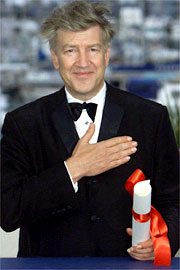
David Lynch with his hand over his heart
Here is the citation for the edition I am using:
Johnson, Jeff. Pervert in the Pulpit: Morality in the Works of David Lynch. North Carolina: McFarland & Company, Inc., Publishers, 2004.

I’ll start by noting that I typically only read critical work that enhances or adds to my appreciation of something I already enjoy. Reading Pervert in the Pulpit has been a totally different experience. This book basically blasts David Lynch, who I’ve considered to be my favorite director since high school. I was extremely skeptical when I started reading. The first sentence on the back of the book states: “Filmmaker David Lynch’s work is viewed here as patriotic and Puritanical.” Whoa! That’s a bold statement for someone who represents the idea of counter-culture and weirdness to so many people (including myself).

After reading Johnson’s introduction, however, I was convinced… or, to be less-dramatic, I was intrigued and could see where his argument was going and how it was probably pretty convincing. As I write these notes, I’m 107 pages into the book. I’ve read Johnson’s analysis of Lynch’s short films and the features Eraserhead, The Elephant Man, Dune, and Blue Velvet. I’m sold on his argument and I’m not sure I’ll ever be able to watch a Lynch film the same way… and I’m not sure that’s a good thing (or am I just being conservative and nostalgic?). Nonetheless, I’m totally enjoying this book and don’t regret reading it.

On to the notes:

Preface

“David Lynch, instead of claiming the mantle of a counterculture hipster with an affinity for outlaws and disenfranchisement, [has] more accurately aligned himself with foot soldiers in the contemporary culture wars, carrying a banner for virtuecrats, neo-cons and Reagan conservatives” (1).

I’ve always considered Lynch to be a “hipster” and “counterculture,” so this statement immediately caught my attention… plus, I hate “virtuecrats” and neo-cons and Reganites, so I was curious to see how Lynch could align with them.

Johnson identifies a

“Calvinist instinct in David Lynch” (1).

I admit that I’m not terribly familiar with the philosophy of John Calvin, except that he was Christian and extremely conservative and that he was very influential in Geneva back in the day.

Johnson found Lynch’s “moral framing” to be more interesting than other critiques of his work.

“I could not look at his work … without identifying his moralistic slant toward mythological ideals of goodness, charity and benevolence threatened by forces of evil” (2).

“his ‘calling’ as a puritanical preacher, albeit one with a penchant for pornography” (2).

When Johnson looked to other critics, they

“self-consciously emerged as apologists for Lynch’s Puritanism” (2).

This has been my experience, as well. The most critical work I’ve read, Slavoj Zizek’s The Art of the Ridiculous Sublime, is very psychoanalysis-heavy, but makes no arguments about Lynch’s morality or ethical constructions.

The critics

“tended to dismiss his conservatism” (2).

Johnson

“relied on the intertextual theories of Schopenhauer, Nietzsche and Freud… these theorists provide a handy vocabulary within with certain patterns of Lynch’s behavior can be both examined and exploited” (3).

“Lynch identifies with authority” (3)

ala Gordon Cole in Twin Peaks.

“Lynch epitomizes the voyeurism inherent in a crusade” (4).

Dale Cooper, Jeffrey Beaumont, Paul Artreides (all played by Kyle MacLachlan — “his alter ego”):

“rationalists plagued by the truth of their dreams” (4).

“I was always aware of watching Lynch watch Jeffrey watch Frank deny Dorothy’s visual pleasure” (4).

“All moralists, as Nietzsche says, are prey to their own morality” (4).

Introduction: Blackbeard, Calvin and the Outer Banks of North Carolina

When Johnson first watched Blue Velvet,

“I watched Blue Velvet every day for a week” (6).

When I first watched Twin Peaks: Fire Walk With Me I watched it every weekend for two months or something like that — so I could identify with Johnson.

“I was fascinated by Lynch’s oddball approach to the ordinary. He seemed like a kinky phenomenologist” (6).

“I was seduced” (6).

From a psychoanalytic standpoint, this is a really funny phrase to use, especially for someone who knows about film theory and the male gaze and whatnot. I’m sure Johnson used this phrase ironically.

Johnson analyzes Dennis Hopper’s acting history, which I think is rather strange, but whatever…:

  • “Redundancy became Hopper’s trademark” (7)
  • He is a “post-abuse neo-conservative” (7)
  • Blue Velvet having become the final repository, the culmination and exhaustion of the motifs and images from all his earlier work” (7)

Lynch’s films

“reinforced a wistful benevolence, projected a vision of nostalgic America that existed only in a Reaganesque, bright-eyed Eagle Scout’s good-deed diary” (9).

“the good people, the elect, are beautiful, wholesome, well-balanced, with a penchant for fifties’ fashion and family values, while the bad people, ugly and carbuncular, deal drugs, engage in promiscuous sex, produce pornography and mock in blatant acts of blasphemy the virtues of American hearth and Heartland” (9, emphasis mine).

This seems pretty par with literature in general — good people are good, bad people are bad… but I guess it’s good to be reminded.

Lynch uses

“desire as a destructive force, the root of evil” (9).

Themes in American literature: guild, sin, and redemption (9)

Lynch is

“a rather straightforward reactionary working within the tradition of typical Calvinist thought in American literature” (10).

“Like Mike Lewis in Michael Powell’s Peeping Tom (1959), Lynch seems to derive a kind of voyeuristic pleasure from indulging in what he condemns” (10).

This is, I think, the key to understanding Johnson’s argument.

“Lynch dodges questions about ‘message'” (11).

Lynch is known for being tight-lipped about his films — he never discusses meanings, interpretations, etc. Is this because he doesn’t want the true message to get out?

“Reading Lynch through Freud is, of course, irresistible; but more than a method of analysis, Freudian readings of Lynch identify a framing device around which Lynch builds his narratives” (11).

I.e. id and ego. I love Freudian readings (and Lacanian readings, more so), so I agree that it is “irresistible.”

“[Lynch] reminds me of a debauched priest asking for prurient details during confession, or a judge who needs to read a pornographic text a few times too many before he deems the material obscene” (12).

This reminds me of a few things: first, Foucault’s discussion of confession and rape trials where people had to give explicit details of their sexual activities in order to “turn on” the priests and judges; second, something I read during my Media Studies class about obscenity trials where jurors and congressmen, etc. would spend obscene amounts of time “studying” and “verifying” the pornographic content.

2047

Android-version of Wang Jing Wen
This a follow-up to my 2046 post. I re-watched the movie and have had more time to process some things. This post may contain spoilers, so if you want some spoiler-free thoughts, checkout the original post.

I wish I could say that the movie made more sense the second time around. Or, wait, no I don’t. The second time around didn’t quite make the movie crystal clear, but it did make me love the movie even more. 2046 is one of those “onion”-type pieces of literature, where there are layers upon layers to peel away — and each time you peel away a layer things are a bit different.

The first time I watched the movie, I admit that the descriptions I read about the movie almost had me more confused than the movie itself. After reading reviews on Netflix and IMDB and whatnot (Netflix: “…Through time travel and parallel worlds…”), I went into it thinking the film was about time travel and alternate universes and what not — well, the movie is strange and has sci-fi elements, but not like that. What made the story confusing was the fact that — and this is my tentative working theory: the movie itself was a story that was mentioned in the movie.

The crux of my understanding comes from a scene early in the film (during whatever year there were major riots in Hong Kong). Chow mentions that he is furiously writing a story called “2046” that is about a place called 2046 that everyone wants to go to and that the story is filled with sex and has a sci-fi plot to it that some people didn’t like where everyone is trying to get to a mysterious place called 2046 — isn’t that pretty much exactly what the film is? As Chow is giving a brief summary of his story, we see futuristic scenes that appear to be depicting the story he describes.

While those could be one way of understanding “2046,” I think the film 2046 is also another way. The movie itself is pretty sexual (take, for instance, the sex scenes between Chow and Bai Ling) and has a strange sci-fi element (the story “2047” that Chow writes for Wang Jen Wen). Furthermore, throughout the film 2046 everyone is trying to get to a 2046 one way or another — either the physical room (e.g. Chow wanting to live in room 2046) or some place where nothing changes (e.g. a stable relationship). So basically what I’m saying is that the interior story of “2046” parallels the larger film of 2046 — the film is itself a metastory.

Anyway, that may be too circular and strange, which is okay. I always make things more confusing that need be, but that’s how I am.

Tak2046
Another thing I was struck by the second time watching was the story of “2047” (see a theme here? me and metastories/intertextualism?). The actress who plays Wang Jen Wen (Faye Wong, who incidentally, I just learned, sang the “love theme song” for Final Fantasy 8 [I knew her name was familiar for some reason]) is phenomenal playing an android. She totally had the jerky movements down and the distant stares that, I would imagine, an android might have. Plus, in the scenes in which Tak asks her to leave with him, when she is pretending to either not listen to not respond to having a delayed response, the “I’m not here”-look she has is great.

Although the movie seems to suggest that Chow’s “true love” was Su Lizhen from In the Mood For Love, I would argue that his best relationship was with Bai Ling. Not only did they seem to have great sex, but they also had a similar history of pushing people away (or so I would assume since she was a prostitute). Also, they seemed to genuinely have fun together. They were playful and joked with each other. I think those types of relationships are probably healthier and have more of a chance to last than those really intense, “I’m so in love with you I could die”-type of relationships (and I think I have some experience here…).

I can’t really tell whether the film (“the film” being, mostly, WKW himself) thinks Chow should go with Bai Ling or move on from Su Lizhen (#1) or give Su Lizhen (#2) a chance or tell Wang Jen Wen that he loves her or what. I want to try to look to “2047” for some help, but I’m still unclear as to what exactly that story is trying to tell us.

Ultimately, despite the fact I’ve tried to do a “close(r) reading” of the film, I think that my first understanding of the overall theme remains the same (and the quote is so lovely it’s worth repeating):

Love is all a matter of timing. It is no good meeting the right person… too soon or too late.

For everything to align correctly so that two people are genuinely 100% in love with each other equally is extremely rare. One person loves the other more than the other (Bai Ling and Chow), one person loves another person but doesn’t know if the love is mutual (Tak and Wang Jen Wen), one person loves the other person at the wrong time (Wang Jen Wen and Tak), one person tries to love someone else who reminds them of someone they used to love (Chow and Su Lizhen #2)… or, who knows what other permutations can exist. I’m sure WKW can show us more.

And for the information-centric readers, here are some other things I’ve learned about the film since my first viewing:

  • 2047 is 50 years after Great Britain returned rule of Hong Kong to China. There was something said by some Chinese leaders about how Hong Kong will remain unchanged (i.e. capitalist) for 50 years. Not sure what this has to do with the movie, but it’s interesting and may give some perspective on the dates 2046 and 2047
  • The version of the film I watched (I’m guessing it’s some sort of “bootleg”) may be the “original cut” of the film that premiered at Cannes. After Cannes WKW decided to edit it a bit and add on five minutes in order to make the film less confusing.
  • It looks like 2046 will be showing at the Seattle Film Festival this year. Although SIFF doesn’t have any information yet, I can’t wait to see 2046 on the big screen.

Where does all of this leave us? I actually plan on going full-on nerd with this film and watching it a couple more times in order to create a timeline or something so that the chronology (there are lots of flashbacks-within-flashbacks going on) is more clear. I think it would make the film more enjoyable and meaningful if I knew exactly what was going on.

They Only Love You When You’re 17

Donatello's David
… when you’re 21, you’re no fun — “Seventeen” by Ladytron.

Rather than go ahead and type up notes for the entire The Use of Pleasure, I think my time would be better spent just typing notes for the “Erotics” chapter since it was the most interesting and the only one I really took anything away from. “Erotics” is the chapter in which Foucault discusses the problematic “relations to one’s own sex” (23). Foucault’s analysis of ancient Greek sexuality involves three aspects: dietetics (regime, diet, risks & dangers), economics (marriage, household), and erotics (sex with boys, the boy’s honor, objects of pleasure).

Erotics/A Problematic Relation

  • “The use of pleasures in the relationship with boys was a theme of anxiety for Greek thought” (187)
  • “the notion of homosexuality is plainly inadequate as a means of referring to an experience, forms of valuation, and a system of categorization so different from ours” (187)
  • “To have loose morals was to be incapable of resisting either women of boys, without it being any more serious than that” (187)
  • bisexual? “simultaneously or in turn, be enamored of a boy of girl” (188)
  • “they did not recognize two kinds of ‘desire,’ two different or competing ‘drives,’ each claiming a share of men’s hearts or appetites” (188)
  • “this option was not referred to a dual, ambivalent, and ‘bisexual’ structure of desire” (188)
  • “what made it possible to desire a man or woman was simply the appetite that nature had implanted in man’s heart for ‘beautiful’ human beings, whatever their sex may be” (188)
  • “the preference for boys or girls was easily recognized as a character trait” (190)
  • “it was not only permitted by the laws (except in particular circumstances), it was accepted by opinion” (190)
  • “a contempt for young men who were too ‘easy,’ or too self-interested; a disqualification of effeminate men…; a disallowance of certain shameful behaviors” (190)
  • “there was a clear awareness of this complexity” (191)
  • “the care fathers took to protect their sons from love affairs” (191)
  • “we affirm that this type [gay] of relation should not be assigned a lesser value, nor given a special status… the Greeks thought very differently about these things: they believed that the same desire attached to anything that was desirable — boy or girl — subject to the condition that the appetite was nobler that included toward what was more beautiful and honorable” (192)
  • “relationship that implied an age difference and, connected with it, a certain difference of status” (193)
  • “very young men were both represented and recognized as highly desirable erotic objects” (194)
  • “passivity was always disliked, and for an adult to be suspected of it was especially serious” (194)
  • disparity of relationship: “made it valuable and conceivable” (195)
  • “a male relationship gave rise to a theoretical and moral interest when it was based on rather pronounced difference on either side of the threshold separating adolescence from manhood” (195)
  • “the other partner, the one who was loved and courted, had to be careful not to yield too easily; he also had to keep from accepting too many tokens of love, and from granting his favors heedlessly and out of self-interest, without testing the worth of his partner; he must also show gratitude for what the lover had done for him” (196)
  • “a whole game of delays and obstacles designed to put off the moment of closure, and to integrate it into a series of subsidiary activities and relations” (197)
  • “in the case of relations between men and boys, we are dealing with a game that was ‘open'” (197)
  • “one could not exercise any statutory authority over the boy… he was free in his choices” (198)
  • “the decision was the boy’s alone to make… one was never sure of winning” (198)
  • “question of timing was important” (199)
  • “it was expressed in different ways — as a problem of ‘limit’ first of all: what was the age limit after which a boy ought to be considered too old to be an honorable partner in a love relation” (199)
  • “this involved the familiar casuistry of the signs of manhood. these were supposed to mark a threshold” (199)
  • “the first beard was believed to be that fateful mark, and it was said that the razor that shaved it must sever the ties of love” (199)
  • “helped to increase people’s sensitivity to the juvenile body, to its special beauty and to the different signs of its development; the adolescent physique became the object of a kind of cultural valorization that was quite pronounced” (200)
  • “in the sphere is sexual ethics, it was the juvenile body with its peculiar charm that was regularly suggested as the ‘right object’ of pleasure” (200)
  • “the double fear so often expressed in the lover, of seeing his beloved lose his charm, and in the beloved, of seeing his lover turn away from him” (201)
  • “it was not good to love a boy who was past a certain age, just as it was not good for him to allow himself to be loved” (201)
  • “on a very general level, this inquiry concerning relationships with boys took the form of a reflection on love” (201)
  • “Eros could unite human beings no matter what their sex happened to be” (202)
  • “the problematization of their relationship belonged to an ‘erotics'” (202)
  • “but in the case of a man or boy who were in a position of reciprocal independence and between whom there was no institutional constraint, but rather an open game (with preferences, choices, freedom of movement, uncertain outcome), the principle of regulation of behaviors was to be sought in the relation itself, in the nature of attraction… carried out in the form of a reflection on the relation itself” (202)
  • “in erotics, the game was more complicated; it implied self-mastery on the part of the lover; it also implied an ability on the part of the beloved to establish a relation of dominion over himself; and lastly, it implied a relationship between their two moderations, expressed in their deliberate choice of one another” (203)

Erotics/A Boy’s Honor

  • “finds expression in a vocabulary that refers constantly to honor and shame” (204)
  • “managed to preserve their honor in the course of their relationship” (205)
  • “especially sensitive to the division between what was shameful and what was proper, between what reflected credit and what brought dishonor” (205)
  • girls now: “their premarital conduct became an important moral and social concern, of itself and for their families” (206)
  • greek boy’s involvement with an older man: “related to his status, his eventual place in the city” (206)
  • trial period: “transitional age, when the young man was so desirable and his honor so fragile” (206)
  • tests as part of greek education: “demeanor of the body”, “one’s gaze”, “one’s way of talking”, “quality of one’s acquaintances” (207)
  • from the symposium: “‘no absolute right and wrong in love, but everything depends upon the circumstances'” (208)
  • “nothing is said concerning what is acceptable or objectionable in physical relations” (208)
  • “everyone must have known what it was honorable or shameful for a boy to consent to” (209)
  • “doubtless to exclude or advise against sexual practices that would be humiliating for the boy, putting him in a position of inferiority” (211) — so are the boys the tops or bottoms?
  • “it was not good (especially in the eyes of public opinion) for a boy to behave ‘passively,’ to let himself be manipulated and dominated, to yield without resistance, to become an obliging partner in the sensual pleasures of the other, to indulge his whims, and to offer his body to whomever it pleased and however it pleased them, out of weakness, lust, or self-interest” (211)
  • “what philosophy can show, in fact, is how to become ‘stronger than oneself’ and when one has become so, it also enables one to prevail over others” (211-212)
  • “where erotics takes the boy’s point of view, the problem is to see how the boy is going to be able to achieve self-mastery in not yielding to others” (212)
  • “later, in european culture, girls or married women, with their behavior, their beauty, and their feelings, were to become themes of special concern” (213)
  • “draw curiosity and desires around them” (213)
  • “there would be accentuation, a valorization, of the ‘problem’ of women. their nature, their conduct, the feelings they inspired or experienced, the permitted or forbidden relationship that one might have with them were to become themes of reflection, knowledge, analysis, and prescription” (213)
  • “in classical greece the problematization was more active in regard to boys, maintaining an intense moral concern around their fragile beauty, their corporal honor, their ethical judgment and the training it required” (213-214)

Erotics/The Object of Pleasure

  • “isomorphism between sexual relations and social relations. what this means is that sexual relations — always conceived in terms of the model act of penetration, assuming a polarity that opposed activity and passivity — were seen as being of the same type as the relationship between a superior and a subordinate, an individual who dominates and one who is dominated, one who commands and one who complies, one who vanquishes and one who is vanquished” (215) — i.e. if someone was penetrated during sex (e.g. women being fucked, men being fucked, anyone giving oral sex to a man) they were assumed to be subordinate and not as superior as the one doing the penetration
  • “this suggests that in sexual behavior there was one role that was intrinsically honorable and valorized without question: the one that consisted in being active, in dominating, in penetrating, in asserting one’s superiority” (215)
  • “as for the woman’s passivity, it did denote an inferiority of nature and condition; but there was no reason to criticize it as behavior, precisely because it was in conformity with what nature intended and with what the law prescribed” (216) — i.e. since women had “no choice” in their role, it wasn’t bad for them to be passive and penetrated… men, on the other hand, had the physical ability to penetrate so being penetrated wasn’t “natural”
  • the boy in a relationship with a man: “his place was not assailable to that of a slave, nor to that of a woman” (216)
  • “in the boy, the deficiency relates to his incomplete development” (217)
  • “among the various legitimate ‘objects,’ the boy occupied a special position. he was definitely not a forbidden object… nothing prevented or prohibited an adolescent from being the openly recognized sexual partner of a man” (217)
  • “an individual who had prostituted himself was disbarred from holding any magistracy in the city” (217-218)
  • “this law made male prostitution an instance of atimia — of public disgrace” (218)
  • “finding certain factors that constitute prostitution (number of partners, indiscriminateness, payment for services)” (218)
  • what made it worse: “placed himself and showed himself to everyone, in the inferior and humiliating position of a pleasure object for others; he wanted this role, he sought it, took pleasure in it, and profited from it” (219)
  • problem with those who were pleasure objects holding public office for other citizens: “they might come under the authority of a leader who once identified with the role of pleasure object for others” (219) — i.e. he wouldn’t be as assertive and superior as they wanted from a leader
  • “when one played the role of subordinate partner in the game of pleasure relations, one could not be truly dominant in the game of civic and political activity” (220)
  • “the difficulty caused, in this society that accepted sexual relations between men, by the juxtaposition of an ethos of male superiority and a conception of all sexual intercourse in the terms of the scheme of penetration and male domination” (220) — i.e. this basically refutes any claims made by people (especially queer theorists/activists) that homosexuality as accepted, practiced, and embraced in classical greek times.
  • “and while this was no problem when it involved a woman or a slave, the case was altered when it involved a man” (220)
  • “one had to keep in mind that the day would come when he would have to be a man, to exercise powers and responsibilities” (220-221)
  • “antinomy of the boy”: “one the one hand, young men were recognized as objects of pleasure — and even as the only honorable and legitimate objects among the possible male partners of men; no one would ever reproach a man for loving a boy, for desiring and enjoying him, provided that the laws and proprieties were respected. but on the other hand, the boy, whose youth must be a training for manhood, could not and must not identify with that role” (221)
  • “but to be an object of pleasure and to acknowledge oneself as such constitute a major difficulty for the boy” (221)
  • “because it feminized one of the partners, whereas the desire that one could have for beauty was nevertheless regarded as natural” (222)
  • “in the phaedrus, the physical form of the relation where a man behaves like a ‘four-footed beast’ is said to be ‘unnatural'” (222) — i.e. doggie style is bad. hehe.
  • “there was a reluctance to evoke directly and in so many words the role of the boy in sexual intercourse” (223) — i.e. the love that dare not speak its name
  • “other times the ‘thing’ is designated by the very impossibility of naming it” (223)
  • “reluctance to concede that the boy might experience pleasure” (223)
  • “affirmation that such a pleasure could not exist and as the prescription that it ought not to be experienced” (223)
  • “and no one was more severely criticized than boys who showed their willingness to yield” (223)
  • “he was only supposed to yield only if he had feelings of admiration, gratitude, or affection for his lover, which made him want to please the latter” (223)
  • “it was not the sharing of a sensation” (224)
  • “he was supposed to feel pleased about giving pleasure to the other” (224)
  • “sexual act… needed to be taken up in a game of refusals, evasions, and escapes that tended to postpone it as long as possible” (224)
  • now: “the viewpoint of the subject of desire: how can it be that a man can desire forms whose object is another man” (225)
  • greeks: “their anxiety focused on the object of pleasure, or more precisely, on that object insofar as he would have to become in turn the master in the pleasure that was enjoyed with others and in the power that was exercised over oneself” (225)
  • point of problemization: “how to make the object of pleasure into a subject who was in control of his pleasures” (225)

You Spun Me Right Round, Baby Right Round

John Leguiazmo in Spun
I’ve been Spun. Jonas Ã…kerlund‘s “ode to crystal meth” (I’m not sure if “ode” is the proper word…), Spun, is the junkiest of all druggie movies I’ve seen (and I consider myself a fan of drug movies…). Not only did the movie totally make me feel like I was on crystal, but it also made me want to be on crystal, which I’m not sure is quite the goal of the movie. (Which is why I initially called the movie an “ode” to the drug.)

Prior to seeing Spun, I only knew of Ã…kerlund due to his music video projects, most notably “Try, Try, Try” by the Smashing Pumpkins (he also did “Beautiful” by Christina Aguilera and “American Life” by Madonna [among others] — so it’s safe to say that he’s into controversial videos). On the Smashing Pumpkins’ Greatest Hits Video Collection there is quite a bit about the video. It basically follows two heroin junkies in Amsterdam (or somewhere in Europe). The DVD contains the “music video” version of the song as well as an extended “director’s cut” (or short film version) that goes more in-depth with the couples lives. The video is extremely graphic and realistic — and, as I recall, there were, of coures, issues with it being played on MTV and other music video channels.

While most art relating to drug-use comes off moralistic and very anti-drug, I would have to say that Ã…kerlund’s stuff is rather sympathetic — and I’m not sure if that is a good thing or a bad thing. The “Try, Try, Try” video really captures the genuine love the two addicts have for each other and how scoring becomes about trying to make the other happy and whatnot. One of the scenes from Spun that I found really interesting was toward the end when Ross and Nikki were in the car on some all-night drive and having a meth-induced conversation — they were really connecting at this strange, primal level that I think only comes via drug use. I’ve never really seen anything like that captured on film before because it seems to be one of the most “positive” (eh, again, I hesitate on the word usage, here…) aspects of using drugs.

Another thing I found really interesting about Spun was the white trash aspect. I’ve realized that my perception of crystal meth is rather skewed because I consider it to be a party drug, when it originated as a “blue collar”/”working class” drug, so I wasn’t expecting the movie to be about a bunch of really ugly, nasty looking people using the drug. In most drug movies I’ve seen, the users start off looking really attractive and eventually end up looking gross by the end — but from the very begining, the characters in Spun were nasty.

I also have to comment on the cast of the movie: it was bizzare. First, we have Jason Schwartzman playing Ross. Now I’ve only seen Schwartzman in Rushmore and I Heart Huckabees, where he plays basically the same type of character (nerdy, off-kilter, etc.). Well, he plays the same type of character in Spun, except this time he’s a meth addict… oh, and he likes to have freaky sex with strippers. Seriously: bizzare. Then we have Brittany Murphy playing Nikki. I guess her playing this role isn’t so bizzare because, to me, she looks like some drug addict (all thin, sunken face, etc.): so nevermind the fact she’s in it. But then John Leguizamo player “Spider” Mike. Now the first time I saw him in a movie was Summer of Sam, in which he plays an angry, fucked-up guy. So I’ve always thought he was twisted. But then I saw him in Moulin Rouge and Spawn and realized he was in Super Mario Brothers: The Movie and is basically considered a comedian. Well, to those who consider this guy to be a comic actor: see Spun and Summer of Sam where he plays fucked up funny guys. Anyway, Mena Suvari was also in the cast, and she looked like shit, which I wouldn’t have expected from her. But the real treat was Mickey Rourke who plays The Cook (the guy who makes all the meth). Now I know lots of critics say that ever since Nine 1/2 Weeks he’s gone downhill, but I’m not sure. This dude is deranged and it shows in movies like Spun and Sin City and even, to some extent, Once Upon a Time in Mexico. I really think Rourke has fun acting and likes to take strange roles just for the hell of it. Maybe I’m trying to give him more credit, I dunno. I just know he’s fun to watch.

So those are the “main characters” of the movie. But like any artsy/entertaining movie, this one has some interesting cameos. First we have Debbie Harry of the group Blondie playing the lesbian neighbor of Ross. I’ve only seen Debbie Harry in two roles, and they were both cameos. She also played a minor part in the movie The Fluffer, one of the worst movies I’ve ever seen. (When Jolie and I saw the movie, I think she was the only non-gay boy in the theatre). In addition to Debbie Harry, Ron Jeremy of pornography (and Surreal Life Season Two) fame plays the bartender at a strip club. Ohh but it gets stranger because Billy Corgan (from the Smashing Pumpkins) plays a doctor. Oh, and Billy also does the music for the film, including a few songs with vocals. I never associate Billy’s soft, feminine voice with crystal meth use, but whatever.

So overall, I think the movie was decent, but I’m not sure about its message — if it even had one. Rather than being grossed out or greatly disturbed, the movie entertained me and sort of made me laugh. The whole cameo-filled thing made the movie a lot less serious than it could have been. The acting was good, but I maybe have issues with fairly well-known actors parodying/playing/pretending to be white trash crystal meth users, but whatever — that’s film for you.

Go J.R. Ewing!

J.R. Ewing
While trying to find an article that fleshes out the similarities between the evil J.R. Ewing from the television series Dallas, I found this article: “Larry Hagman slams US president over Iraq.” Dude, Larry Hagman (who played J.R. on Dallas) is fucking hard-core!

Look at this quote:

JR Ewing in the Dallas series, said Bush was a “sad figure: not too well educated, who doesn’t get out of America much. He’s leading the country towards facism.” … When asked whether Bush would appreciate his accusation, Hagman replied: “It’s all the same to me, he wouldn’t understand the word facism anyway.”

So yeah, Larry Hagman basically called the president a facist. Daaaamn!